Skip to content
SnapVoyagesIndependent cruise information
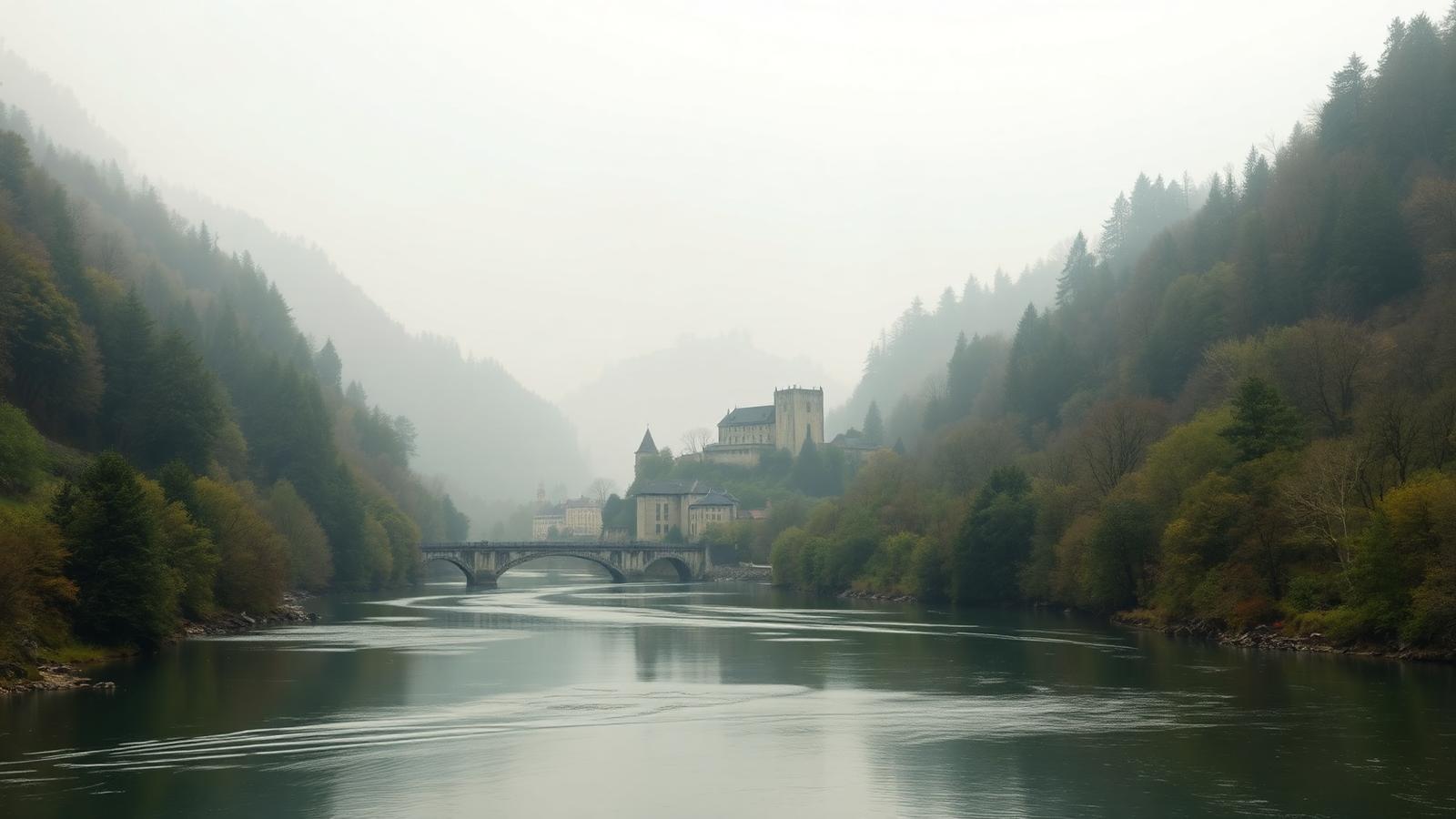
Illustrative AI-generated scene of a broad river between steep wooded hillsides with a castle silhouette in soft haze

River cruise system

Rhine River Cruises

The Rhine runs from the Swiss Alps to the North Sea and is the busiest inland waterway in Europe. Cruising it means a short, dense corridor: a few hundred kilometres linking Switzerland, France, Germany and the Netherlands, with one famous gorge at its centre.

The short answer

The Rhine is shorter and more compressed than the Danube. Between Basel and Amsterdam the corridor crosses four countries in under a thousand kilometres, and the cities come close together, which means shorter cruising legs and more time tied up than on the lower Danube.

One stretch dominates. The Upper Middle Rhine Valley between Bingen and Koblenz is a UNESCO World Heritage cultural landscape of vineyard slopes and hillside castles, and it can be seen in a single afternoon from the deck. Almost every Rhine voyage is arranged so that this stretch is passed in daylight.

At a glance

Where it runs
Western Europe, from the Swiss Alps to the North Sea
Length
About 1,230 km from source to sea
Countries
Flows through or borders Switzerland, Liechtenstein, Austria, Germany, France and the Netherlands
Cruised stretch
Mainly Basel to Amsterdam or Rotterdam
Season
Roughly April to October, with a December Christmas-market period
Main start and end points
Basel, Amsterdam, Rotterdam

The Rhine as a corridor

  1. River

    Rhine

    Western Europe, from the Swiss Alps to the North Sea

  2. Cruised stretch

    Mainly Basel to Amsterdam or Rotterdam

  3. Stretches

    3 in downstream order

    Upper Rhine → Middle Rhine → Lower Rhine and the Dutch delta

  4. Places along it

    13 cities and stops

    Listed in downstream order further down this page.

Why a river is not a region

One waterway, in a fixed order

A cruise region can be entered from several directions. A river corridor can only be travelled upstream or downstream along the same line.

It is also a working river. Cruise vessels share the channel with continuous freight traffic, and in the Dutch reaches the landscape is delta and port rather than valley. That mix — heritage gorge and industrial waterway in the same voyage — is a fair description of what the Rhine actually is.

The Rhine corridor

The river's own course, with the cities river cruises use. Select a stretch to focus on it.

SWITZERLANDNETHERLANDSGERMANYBELGIUMBaselBreisachStrasbourgSpeyerMainzRüdesheim am RheinKoblenzCologneDüsseldorfNijmegenKinderdijkRotterdamAmsterdam

Every city on the map

  • BaselSwitzerland, start or end point.
  • BreisachGermany, stop along the way, serving the Black Forest and Colmar in Alsace.
  • StrasbourgFrance, stop along the way.
  • SpeyerGermany, stop along the way.
  • MainzGermany, stop along the way.
  • Rüdesheim am RheinGermany, stop along the way.
  • KoblenzGermany, stop along the way.
  • CologneGermany, stop along the way.
  • DüsseldorfGermany, stop along the way.
  • NijmegenNetherlands, stop along the way.
  • KinderdijkNetherlands, stop along the way.
  • RotterdamNetherlands, start or end point.
  • AmsterdamNetherlands, start or end point.

The line is the river's own course, not the track of any voyage. Cities are the ones needed to understand the corridor, not a complete list of everywhere a vessel can tie up.

What cruising the Rhine actually means

A short corridor with close-spaced cities
Stops are rarely far apart, so voyages spend comparatively little time under way and more time moored. That is a structural property of the route, not a service level.
One dominant scenic stretch
The 65 km gorge between Bingen and Koblenz carries most of the visual interest. Upstream and downstream of it the river is engineered, flat or industrial.
Locks only on the upper river
Between Basel and Iffezheim the river is regulated by barrages with locks. Below that it runs free all the way to the sea, so most of the corridor has no lock transits at all.
Water level is the main variable
Because the middle river is not regulated by barrages, its depth follows rainfall. Prolonged low water restricts navigation on exactly the stretch that matters most.
Four countries, one waterway
Switzerland, France, Germany and the Netherlands are all reachable within a single voyage, without any of the sea crossings an equivalent ocean itinerary would need.
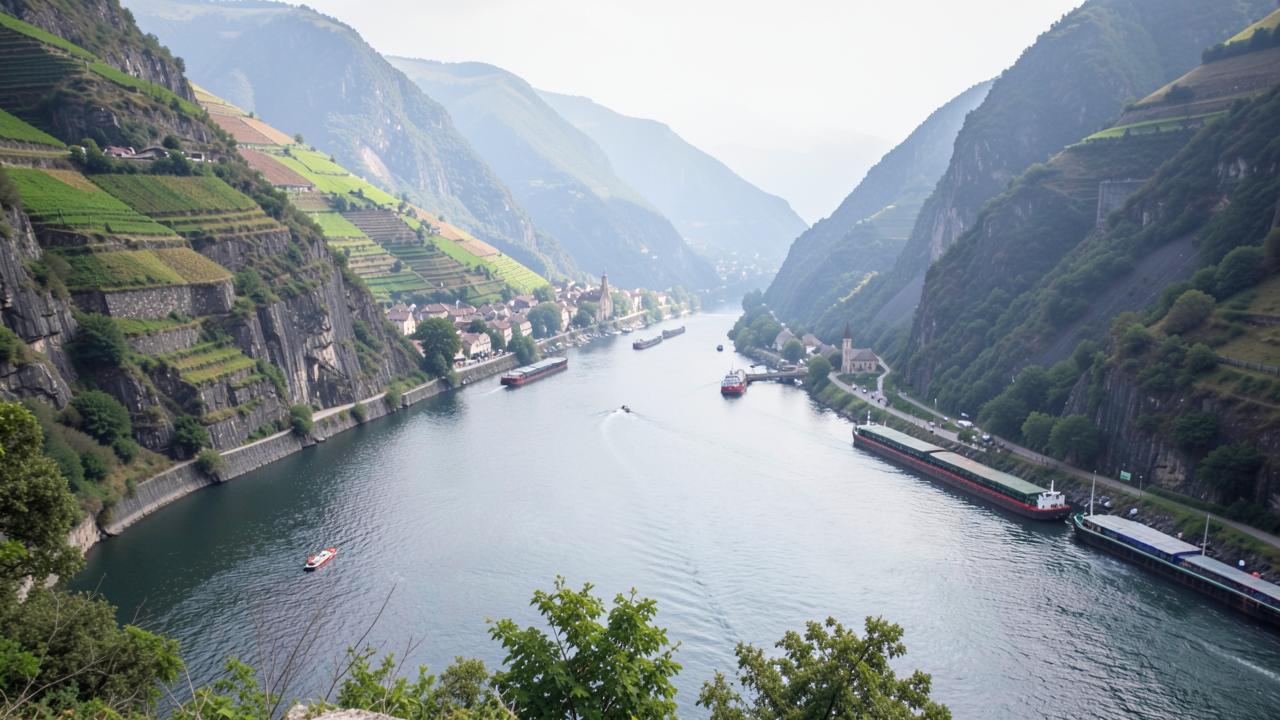
A busy river winding through a narrow valley with vineyard terraces, a small riverside town and cargo barges
A working freight waterway and a scenic valley at once: terraced slopes, closely spaced towns and commercial traffic sharing the same channel.

Why the Rhine feels busy in a way other rivers do not

The Rhine is first of all a working waterway. It connects the North Sea ports to the industrial interior of Germany and Switzerland, and it carries a very large volume of commercial barge traffic. Passenger vessels share the channel with that traffic, follow the same navigation rules and queue for the same locks, which is one reason schedules on the Rhine are held to closely.

That working character also explains the landscape you actually pass. Long parts of the corridor are ports, refineries, bridges and freight terminals, and they sit between the stretches people come for. The famous section is short: the Middle Rhine gorge between Rüdesheim and Koblenz, where the river cuts through slate hills lined with castles and terraced vineyards, is measured in tens of kilometres, not hundreds.

Because of that, the Rhine rewards knowing when the ship is where. A gorge transit is scheduled for daylight in a way an industrial reach is not, and a voyage that includes the Dutch delta at one end is buying flat, wide, open water rather than more castles.

What the corridor really is

A freight artery with scenic sections inside it

Commercial barges, not cruise vessels, are the majority of the traffic. The cruise experience is fitted into an existing transport system rather than the other way round.

The main stretches

A river has an order rather than fuzzy edges. These are the stretches the corridor divides into, in the direction the water flows.

Upper Rhine

Basel downstream to MainzSwitzerland, France, Germany

A straightened, canalised river running through the flat rift valley between the Vosges and the Black Forest. The interest here is the cities and the country on either bank — Basel, Strasbourg, Speyer — rather than the riverscape itself, which is engineered and largely uniform.

Navigation: Locks are concentrated on this stretch: the barrages between Basel and Iffezheim regulate the river, and vessels transit several of them. Below Iffezheim the Rhine runs free.

Middle Rhine

Bingen through the gorge to Koblenz and on to BonnGermany

The Upper Middle Rhine Valley, a UNESCO World Heritage cultural landscape: roughly 65 kilometres of steep vineyard slopes, hillside castles and small towns squeezed between the water and the rock. This short stretch is the reason most Rhine cruises exist in the shape they do.

Navigation: Free-flowing, no locks, but narrow and fast, with a shifting channel. It is also the stretch most sensitive to low water, because depth is not regulated by barrages here.

Lower Rhine and the Dutch delta

Cologne downstream through Nijmegen to Rotterdam and AmsterdamGermany, Netherlands

A wide, working river through an industrial and then a deltaic landscape. The Rhine splits into several arms in the Netherlands and connects to Amsterdam by canal, which is why so many Rhine voyages start or end in a Dutch city rather than on the Rhine proper.

Navigation: The busiest inland waterway in Europe by freight volume, so cruise vessels share the channel with continuous commercial barge traffic. Tidal influence begins in the Dutch reaches.

Cities and stops along the river

The main places along the corridor, in downstream order within each stretch.

Cities and stops used by Rhine river cruises
PlaceCountryStretchRoleWhy it matters
BaselSwitzerlandUpper RhineStart or end pointThe practical head of navigation for cruise vessels, and the usual southern start or end point.
BreisachGermanyUpper RhineStop along the wayServes the Black Forest and Colmar in Alsace.
StrasbourgFranceUpper RhineStop along the wayMoorings are on the Rhine or the connecting canal, not in the historic centre, so the city is reached by transfer.
SpeyerGermanyUpper RhineStop along the wayAn upper Rhine town in the Palatinate, known for its Romanesque cathedral.
MainzGermanyUpper RhineStop along the wayWhere the Main joins the Rhine — the junction for voyages continuing towards the Main–Danube Canal.
Rüdesheim am RheinGermanyMiddle RhineStop along the wayAt the upstream entrance to the Upper Middle Rhine Valley gorge.
KoblenzGermanyMiddle RhineStop along the wayAt the downstream end of the gorge, where the Moselle joins the Rhine.
CologneGermanyMiddle RhineStop along the wayMoorings sit on the riverfront below the cathedral, so the centre is reached on foot.
DüsseldorfGermanyLower Rhine and the Dutch deltaStop along the wayA city on the lower Rhine downstream of Cologne.
NijmegenNetherlandsLower Rhine and the Dutch deltaStop along the wayOn the Waal, the main Dutch distributary of the Rhine.
KinderdijkNetherlandsLower Rhine and the Dutch deltaStop along the wayA UNESCO-listed windmill and drainage landscape in the delta, reachable directly from the water.
RotterdamNetherlandsLower Rhine and the Dutch deltaStart or end pointThe seaward end of the Rhine corridor and a common northern start or end point.
AmsterdamNetherlandsLower Rhine and the Dutch deltaStart or end pointNot on the Rhine itself; it is connected by the Amsterdam–Rhine Canal and is the most used northern turnaround.

How voyages are structured

The shapes voyages take along this corridor: where they start, which way they run and how far they reach.

Basel to Amsterdam or Rotterdam

The standard full-corridor voyage, running the length of the cruised Rhine in one direction and passing the gorge roughly midway.

Middle Rhine short voyages

Shorter voyages concentrated between the Dutch cities and Koblenz or Mainz, built around the gorge and the nearby cities rather than the whole river.

Rhine with the Moselle or the Main

Voyages that leave the Rhine at Koblenz for the Moselle, or at Mainz for the Main. Different rivers with their own locks and dimensions, joined to the Rhine corridor.

When voyages operate

The Rhine does not freeze in normal winters, so the season is shaped by daylight, weather on deck and what is open ashore. Voyages build from April, run steadily through summer, and continue through a well-defined autumn period.

December is again a distinct pattern of short Christmas-market voyages between the German and Dutch cities, with little time under way and most of the interest ashore.

Late summer is when low water is most likely on the free-flowing middle river, and heavy winter and spring rain is when high water most often restricts bridge clearance. Neither is predictable far ahead.

Cruise activity through the year — the Rhine
Essentially no cruisesLow seasonShoulder periodPeak cruise activity
Read this as a table
Relative cruise activity by month in the the Rhine cruise region
MonthCruise activity
JanEssentially no cruises
FebEssentially no cruises
MarLow season
AprShoulder period
MayPeak cruise activity
JunPeak cruise activity
JulPeak cruise activity
AugPeak cruise activity
SepPeak cruise activity
OctPeak cruise activity
NovLow season
DecShoulder period

An indicative pattern of when voyages operate, drawn from waterway and season information rather than from any operator's schedule.

Practical conditions that shape a voyage

Conditions on this river that can change what actually happens on a voyage.

Low water on the middle river

The unregulated stretch between Mainz and Bonn is the first to become too shallow in a dry summer. Operators may transfer passengers between vessels moored on either side of the affected reach.

Not every city mooring is central

Cologne moors below the cathedral; Strasbourg does not moor in the historic centre at all. Whether a stop is a walk or a bus ride varies city by city.

Amsterdam is a canal connection, not the Rhine

Voyages that begin or end in Amsterdam reach it by the Amsterdam–Rhine Canal. It is a normal part of the corridor, but it is not the river itself.

Commercial traffic sets the rhythm

This is Europe's busiest inland freight route. Lock queues on the upper river and channel traffic below it are ordinary conditions, not disruptions.

What to know about the Rhine

Key facts

  • About 1,230 km long, from the Swiss Alps to the North Sea.
  • By freight volume it is the busiest inland waterway in Europe.
  • The cruised corridor is effectively Basel to the Dutch delta.
  • The Upper Middle Rhine Valley, roughly 65 km between Bingen and Koblenz, is a UNESCO World Heritage cultural landscape.
  • Locks are concentrated between Basel and Iffezheim; below Iffezheim the river is free-flowing.
  • The Main joins at Mainz and the Moselle at Koblenz, giving access to two further cruised rivers.
  • Amsterdam is reached from the Rhine by canal rather than by the river itself.

What to check when comparing voyages

  • Whether the gorge between Bingen and Koblenz is scheduled in daylight.
  • Which end the voyage starts from, since that decides the direction through the gorge.
  • How many stops are walk-off moorings versus transfers.
  • What the operator states about low or high water, and whether it can affect the middle stretch.
  • Whether the voyage also runs the Moselle or the Main, which are separate rivers with their own character.
  • Whether a December departure is a Christmas-market voyage rather than a normal sailing.
  • Danube river cruises

    A west-to-east corridor from Germany to the Black Sea, cruised mainly between Passau, Vienna, Budapest and the Danube Delta.

  • Seine river cruises

    A short French corridor from Paris downstream through Normandy to Rouen and the Seine estuary.

  • Rhône & Saône river cruises

    A north–south French corridor from Burgundy through Lyon to Provence and the Camargue.

  • Douro river cruises

    A short Portuguese valley from Porto upstream through the terraced Alto Douro wine country to the Spanish border.

  • Main and the Main–Danube Canal river cruises

    The German connecting corridor from the Rhine at Mainz through Franconia and the Main–Danube Canal to Kelheim.

  • Moselle river cruises

    A narrow German wine valley from the Rhine at Koblenz upstream past Cochem and Bernkastel to Trier and Luxembourg.

  • Elbe river cruises

    A Czech–German corridor from Prague and the sandstone gorge through Dresden and Magdeburg to Hamburg.

  • Nile river cruises

    A short Egyptian reach between Luxor and Aswan linking the temple sites, plus a separate Lake Nasser circuit.

  • Mekong river cruises

    A Vietnam–Cambodia corridor from the Mekong delta through Phnom Penh towards the Tonlé Sap and Angkor.

  • Mississippi river cruises

    The long North American corridor from New Orleans upstream to St. Paul, with Ohio and Cumberland connections.

  • Columbia & Snake river cruises

    A Pacific Northwest corridor from Astoria and Portland through the Columbia Gorge and up the Snake to Idaho.

  • How river cruising differs from ocean cruising

    The structural differences: locks, water level, city-centre mooring and no sea days.

Sources & verification

Facts on this page are taken from the sources below. Cruise lines are used only as sources for facts about their own operations, never as sources of independent assessment.