Before you book
Cabins explained
Two decisions, not one: which category, and where on the ship.
The short answer
Cabin choice sits alongside the itinerary as a main decision, because it sets both the price and the daily experience.
The category — inside, oceanview, balcony or suite — is the first axis. Position on the ship is a separate one, and it changes motion, noise and walking distance regardless of which category you pick.
Axis one
The four broad categories
Nearly every ocean ship sorts its cabins into the same four types, in the same order.
Increasing space, light and price →
Inside (interior)
No window
Normally the smallest and least expensive category. Fully dark when the lights are off, which some people prefer and others find disorienting because there is no natural cue to time of day. Some ships fit virtual windows showing an outside camera feed.Oceanview (outside)
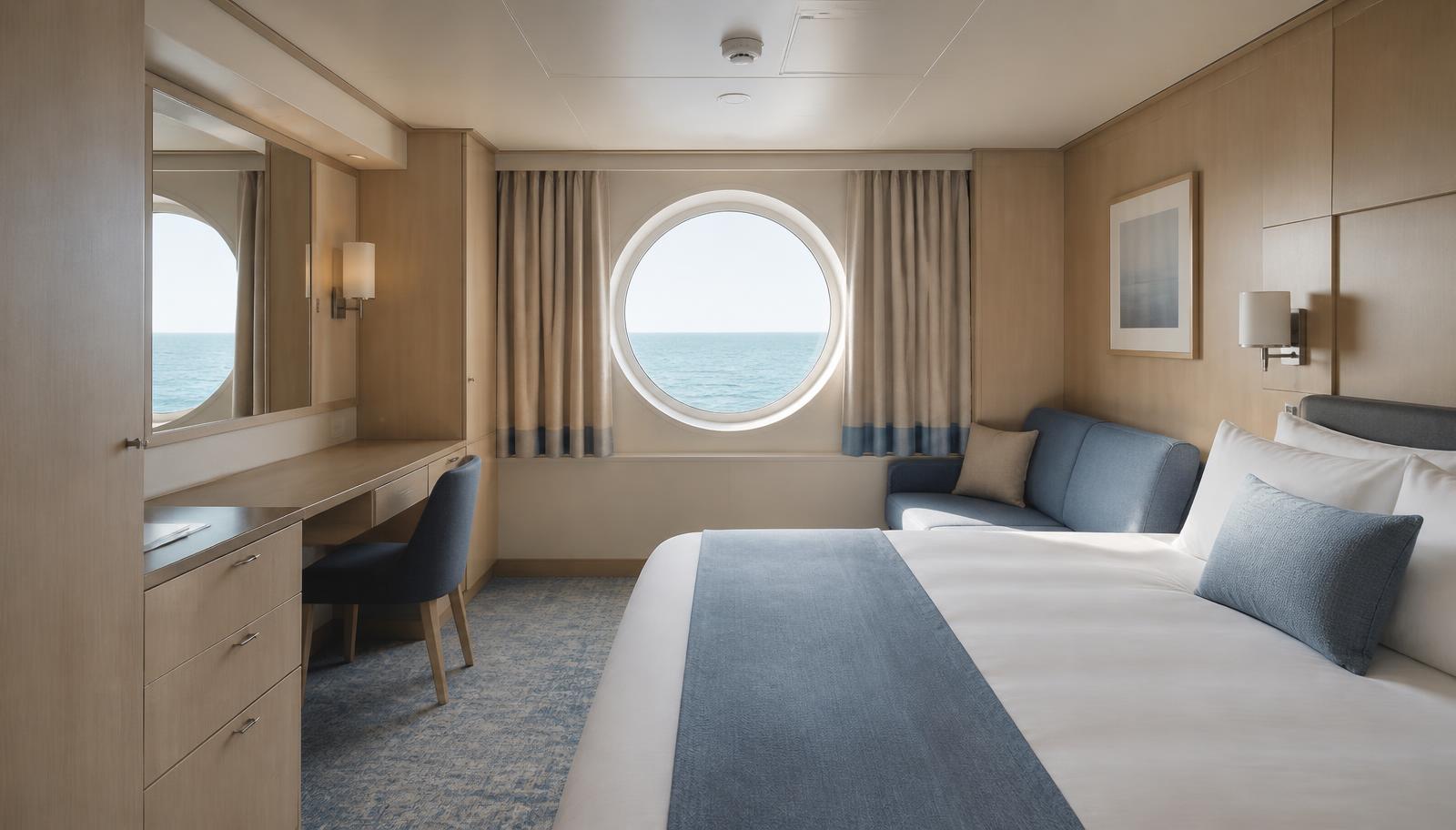
Fixed window or porthole
Daylight and a sense of position, without outdoor space. On some ships the view is partly blocked by lifeboats or equipment, which is normally disclosed in the category description.Balcony (veranda)
Private outdoor space
The practical value depends heavily on the itinerary: high in scenic-cruising regions such as fjords, Alaska or expedition areas, lower on itineraries that are mostly warm-weather port days when you are ashore. Some ships instead offer French balconies — a full-height door with a railing and no usable floor space.Suite
More space, often a service tier
Usually a separate sitting area. On many lines a suite also carries priority boarding, a dedicated restaurant or lounge, included items, or a butler. That bundled tier, rather than the square metres, is often the real difference in price.
Within each category, lines subdivide into numbered or lettered grades that differ mainly by deck and position rather than by cabin type. A higher grade is not a different product.
A warning about vocabulary
Category names are line-specific
There is no industry-standard cabin vocabulary
“Deluxe”, “premium”, “club”, “concierge” and “mini-suite” mean whatever a given line defines them to mean, and the same word can describe different things on two ships in the same fleet.
Axis two
Where the cabin sits
Position on the ship changes the experience in ways that are consistent regardless of the line.
- Motion
- Movement is felt least low down and near the middle of the ship, and most at the extreme forward and aft ends and on high decks. This is geometry, not brand.
- Noise
- Cabins directly below pool decks, theatres, nightclubs or the galley, and those next to lift shafts or crew access, are the ones most likely to carry noise. Cabins sandwiched between other cabin decks are the quietest.
- Walking distance
- On a large ship, being far forward or far aft means a long internal walk to lifts, dining and the gangway several times a day.
- Connecting and family layouts
- Connecting doors, sofa beds and upper berths let a cabin sleep three or four, usually with a real reduction in floor space.
River and expedition vessels are far smaller, so these differences compress: there are few decks, short distances and often no inside cabins at all. See river cruising and expedition cruising.
A limited inventory
Accessible cabins
Lines designate a limited number of accessible cabins with wider doors, step-free bathrooms and turning space. They are limited in number and often sell early, and eligibility criteria and required documentation vary by operator.
Accessibility on board is not the same as accessibility ashore: tender ports in particular can be unavailable to wheelchair users depending on sea state. General principles are on practical basics; the operator confirms the specifics.
A choice between the two axes
Guarantee fares and price
A guarantee fare is the point where category and location stop being separate decisions.
A “guarantee” fare buys a category rather than a specific cabin; the line assigns the cabin later, sometimes shortly before departure, and may assign a higher category. The trade-off is price against control over location — which matters more if motion, noise or walking distance is a real constraint for you.
Cabin category is normally the single biggest lever on the base fare, and on many lines the service charge and any included items differ by category too. The overall structure is on what a cruise fare includes. Specific cabin numbers and deck plans are ship-specific, change with refits, and are published by the operator.