Skip to content
SnapVoyagesIndependent cruise information

Operators

Cruise lines

What actually varies between operators — and which lines sail where. Factual overviews only, listed alphabetically.

The short answer

Cruise lines differ mainly in structural ways: the size and type of the ships they operate, the regions and seasons they deploy them in, how the onboard day is organised, what the fare covers, and whether the cruise is sold together with a land programme.

The line, though, decides fewer things than its name suggests. A single company can run a 3,000-berth ship on a port-dense Mediterranean week and a 900-berth ship on a fjord itinerary in the same summer. Those two voyages differ more from each other than either differs from a comparable sailing on another line.

Four separate variables

The line is one layer, not the whole voyage

Most disappointment traced back to the wrong layer. Each of these is chosen separately, and each governs a different part of the trip.

  1. Layer 1

    The cruise line

    Sets commercial and operating conventions: how dining and scheduling are organised, what the fare tends to bundle, which service charges apply and which home markets the itineraries are written for.

  2. Layer 2

    The ship

    Sets the physical environment: how many passengers share the venues, which facilities exist at all, cabin categories available, and which berths and locks the hull can physically use.

  3. Layer 3

    The itinerary

    Sets where the voyage goes and how it moves — how many calls, how many sea days, whether a call is docked or tendered, and how much of each day is actually ashore.

  4. Layer 4

    The specific sailing

    Sets the date, and with it season, daylight, weather exposure and the operational context that can change a published call at short notice.

This is why the question “which cruise line?” cannot answer questions about crowding, port time, cabin choice or included services. Those are answered one layer down. The line narrows the field; the ship, itinerary and date decide the voyage.

Comparison dimensions

Six things that genuinely differ

Use these as the axes of comparison. Everything below them — atmosphere, style, reputation — is marketing language rather than a checkable fact.

  1. 01

    Fleet and ship scale

    Ships range from a few hundred passengers to several thousand. Ship size affects which ports a ship can enter, how many venues are on board, and how embarkation and tendering feel.

    Ask: How large are the ships used on the itinerary you are looking at?

  2. 02

    Regions served

    Not every line operates in every region, and deployment changes by season. A line's presence in a region is a fact you can check against its own published destination pages.

    Ask: Does the line actually deploy ships in the region and season you want?

  3. 03

    Onboard model

    Lines differ in how dining, entertainment and daily scheduling are organised — for example fixed dining times versus open dining. These are structural differences, not quality judgements.

    Ask: Is the daily structure fixed, flexible, or built around specific programming?

  4. 04

    Fare structure

    What the fare covers varies: drinks, Wi-Fi, gratuities, speciality dining and excursions may be included, bundled or charged separately. Compare the inclusions of a specific fare, not the brand.

    Ask: What is included in the specific fare, rather than in the brand's general positioning?

  5. 05

    Land programmes

    Some lines sell cruises combined with their own land itineraries, which is particularly relevant in Alaska.

    Ask: Is the cruise sold on its own, or as part of a longer land-and-sea itinerary?

  6. 06

    Home market and home ports

    Where a line is based shapes which home ports it sails from and which market its itineraries are written for — a UK-based line sailing from Southampton produces a different trip shape than a fly-cruise from a Mediterranean gateway.

    Ask: Where does the itinerary start, and does that mean a flight or a drive for you?

Fleet

Why the fleet a line operates changes your day

Fleet composition is the most consequential factual difference between operators, because hull dimensions decide what is physically possible before any commercial decision is taken.

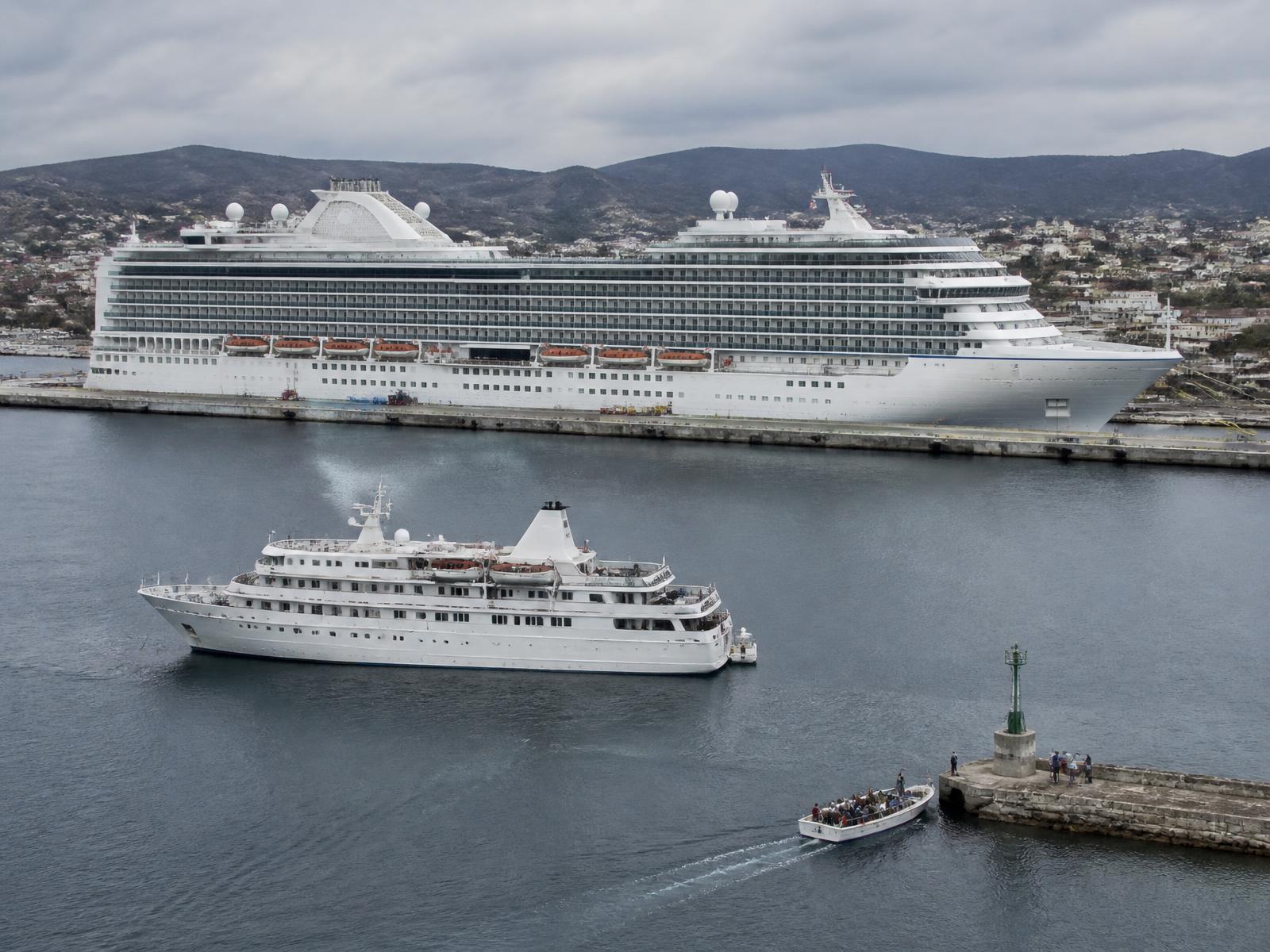
A very large cruise ship alongside a long quay while a much smaller vessel lies at anchor offshore and a tender carries passengers to a stone jetty

The two vessels here are in the same harbour on the same day and are having two different days. One is alongside, with passengers walking off onto the quay from the moment clearance is given. The other is at anchor, and every passenger ashore travels by tender in sequence.

That difference is set by the ship, and the ship comes with the line you book. A fleet of large vessels concentrates on ports with deep berths and the landside capacity to absorb thousands of arrivals; a fleet of smaller vessels can use berths the larger hulls cannot, but carries fewer venues.

Which ports are reachable at all
Berth length, draught and, on rivers, lock chamber and bridge clearance are hard limits. A line whose fleet sits above a corridor's limits cannot sell that corridor, whatever its marketing says.
Docked or tendered
Where a ship exceeds what a port can take alongside, passengers go ashore by tender. That converts part of the scheduled call into queueing and boat time for everyone aboard.
How many people share each space
A larger ship has more venues, but also more passengers per venue, per lift and per gangway. Facility count and passenger density move together, and only one of them is advertised.
What the ship can devote space to
Pools, theatres, speciality restaurants, promenades and expedition equipment all need volume. A small hull spends its volume differently, not worse.
Fleet uniformity
Some operators run near-identical sister ships, so the onboard environment is broadly predictable across the fleet. Others run vessels built decades apart, and the same brand then delivers materially different ships.
Specialised capability
Ice-strengthened hulls, zodiac launching arrangements and shallow-draught river vessels are equipment decisions, not styling. They determine which operating areas an operator can work in.

Ships explained sets out the size categories and what each one changes in practice.

Deployment

Which lines operate in which region

A mark below records that the operator publishes itineraries in that region. It does not say how many ships, how often, or in which months.

Cruise lines and the SnapVoyages regions they operate in
Cruise lineMediterraneanCaribbeanAlaskaNorwegian FjordsBaltic and Northern EuropeAsia
AIDA CruisesOperates in MediterraneanNot recorded in SnapVoyages data for CaribbeanNot recorded in SnapVoyages data for AlaskaOperates in Norwegian FjordsOperates in Baltic and Northern EuropeNot recorded in SnapVoyages data for Asia
Carnival Cruise LineNot recorded in SnapVoyages data for MediterraneanOperates in CaribbeanOperates in AlaskaNot recorded in SnapVoyages data for Norwegian FjordsNot recorded in SnapVoyages data for Baltic and Northern EuropeNot recorded in SnapVoyages data for Asia
Celebrity CruisesOperates in MediterraneanOperates in CaribbeanOperates in AlaskaOperates in Norwegian FjordsOperates in Baltic and Northern EuropeOperates in Asia
Costa CruisesOperates in MediterraneanOperates in CaribbeanNot recorded in SnapVoyages data for AlaskaOperates in Norwegian FjordsNot recorded in SnapVoyages data for Baltic and Northern EuropeOperates in Asia
Cunard LineOperates in MediterraneanOperates in CaribbeanNot recorded in SnapVoyages data for AlaskaOperates in Norwegian FjordsOperates in Baltic and Northern EuropeOperates in Asia
Disney Cruise LineOperates in MediterraneanOperates in CaribbeanOperates in AlaskaNot recorded in SnapVoyages data for Norwegian FjordsNot recorded in SnapVoyages data for Baltic and Northern EuropeNot recorded in SnapVoyages data for Asia
Fred. Olsen Cruise LinesOperates in MediterraneanNot recorded in SnapVoyages data for CaribbeanNot recorded in SnapVoyages data for AlaskaOperates in Norwegian FjordsOperates in Baltic and Northern EuropeNot recorded in SnapVoyages data for Asia
Holland America LineOperates in MediterraneanOperates in CaribbeanOperates in AlaskaOperates in Norwegian FjordsOperates in Baltic and Northern EuropeOperates in Asia
MSC CruisesOperates in MediterraneanOperates in CaribbeanNot recorded in SnapVoyages data for AlaskaOperates in Norwegian FjordsOperates in Baltic and Northern EuropeOperates in Asia
Norwegian Cruise LineOperates in MediterraneanOperates in CaribbeanOperates in AlaskaOperates in Norwegian FjordsOperates in Baltic and Northern EuropeOperates in Asia
P&O CruisesOperates in MediterraneanOperates in CaribbeanNot recorded in SnapVoyages data for AlaskaOperates in Norwegian FjordsOperates in Baltic and Northern EuropeNot recorded in SnapVoyages data for Asia
Princess CruisesOperates in MediterraneanOperates in CaribbeanOperates in AlaskaOperates in Norwegian FjordsOperates in Baltic and Northern EuropeOperates in Asia
Royal Caribbean InternationalOperates in MediterraneanOperates in CaribbeanOperates in AlaskaOperates in Norwegian FjordsOperates in Baltic and Northern EuropeOperates in Asia
Virgin VoyagesOperates in MediterraneanOperates in CaribbeanNot recorded in SnapVoyages data for AlaskaNot recorded in SnapVoyages data for Norwegian FjordsNot recorded in SnapVoyages data for Baltic and Northern EuropeNot recorded in SnapVoyages data for Asia

A dash means no sourced presence has been recorded for that line in that region — not that the line never sails there.

Reading a deployment mark honestly

Presence in a region can mean a year-round programme with several ships, a single vessel for one summer season, or a couple of repositioning calls on the way somewhere else. All three appear identically in a matrix like this one, so the mark is a starting point for a search on the operator’s own site rather than a description of scale.

Deployment is also seasonal by nature. Ships are moved to follow weather and demand, which is why the same hull can be in the Caribbean in February and Alaska in July, and why a region can be well served in one month and effectively empty in another. What is published for next season is the only reliable answer for next season.

Two fares can carry the same number and contain different things

Operators draw the line between the fare and the extras in different places. Dining beyond the main restaurant, drinks, Wi-Fi, service charges, shore excursions, airport transfers and speciality venues can each sit inside the fare, inside an optional bundle, or on the onboard account.

This makes headline comparison between lines unreliable in a specific way: the fare that looks lower may exclude services that the higher one includes, and the difference only appears at the end of the voyage. Comparing the two means listing the services you would actually use and checking, for each one, which side of the line it falls on for that fare.

Inclusion structures also vary within a single line — by market, by fare grade and by promotion — so the answer comes from the specific fare on the specific sailing rather than from the brand.

What a cruise fare includes works through the layers of the total cost in detail.

A–Z

The lines

The ocean operators recorded for the regions covered here, alphabetically. Each entry states what the company operates and where, with a link to its own site for anything that changes season to season.

AIDA Cruises

Based in Germany3 of 6 regions

German-market operator with a large northern European summer programme from Hamburg, Kiel and Warnemünde, covering both the Norwegian coast and the Baltic.

Regions covered here: Mediterranean, Norwegian Fjords, Baltic and Northern Europe

Official website

Carnival Cruise Line

Based in United States2 of 6 regions

Operates mainly from North American home ports, with a large share of its deployment in the Caribbean and short Bahamas sailings, plus a seasonal Alaska programme.

Regions covered here: Caribbean, Alaska

Official website

Celebrity Cruises

Based in United States6 of 6 regions

Operates mid-size and large ships positioned by the company in the premium segment, with deployment across several of the regions covered here.

Regions covered here: Mediterranean, Caribbean, Alaska, Norwegian Fjords, Baltic and Northern Europe, Asia

Official website

Costa Cruises

Based in Italy4 of 6 regions

Italian brand with an itinerary and onboard model aimed primarily at European guests, and a substantial Mediterranean deployment.

Regions covered here: Mediterranean, Caribbean, Norwegian Fjords, Asia

Official website

Cunard Line

Based in United Kingdom5 of 6 regions

Operates a small fleet including a ship built for transatlantic crossings, with seasonal northern European itineraries and long voyages between regions.

Regions covered here: Mediterranean, Caribbean, Norwegian Fjords, Baltic and Northern Europe, Asia

Official website

Disney Cruise Line

Based in United States3 of 6 regions

Operates a comparatively small fleet with onboard programming built around Disney intellectual property, and a seasonal presence in several of the regions covered here.

Regions covered here: Mediterranean, Caribbean, Alaska

Official website

Fred. Olsen Cruise Lines

Based in United Kingdom3 of 6 regions

Operates smaller ships from regional UK ports, which allows calls at some northern European berths that larger ships cannot use.

Regions covered here: Mediterranean, Norwegian Fjords, Baltic and Northern Europe

Official website

Holland America Line

Based in United States6 of 6 regions

Operates mid-size ships and, like Princess, combines Alaska sailings with its own land-tour programme in the Alaska interior.

Regions covered here: Mediterranean, Caribbean, Alaska, Norwegian Fjords, Baltic and Northern Europe, Asia

Official website

MSC Cruises

Based in Switzerland / Italy5 of 6 regions

European-headquartered operator with a large Mediterranean programme, including year-round sailings in the western Mediterranean, and a growing Caribbean deployment from Florida.

Regions covered here: Mediterranean, Caribbean, Norwegian Fjords, Baltic and Northern Europe, Asia

Official website

Norwegian Cruise Line

Based in United States6 of 6 regions

Operates a mixed fleet of mid-size and large ships and markets a flexible dining and scheduling model rather than fixed dining times.

Regions covered here: Mediterranean, Caribbean, Alaska, Norwegian Fjords, Baltic and Northern Europe, Asia

Official website

P&O Cruises

Based in United Kingdom4 of 6 regions

British-market operator sailing mainly from UK home ports, which means northern European itineraries begin with a North Sea crossing rather than a flight.

Regions covered here: Mediterranean, Caribbean, Norwegian Fjords, Baltic and Northern Europe

Official website

Princess Cruises

Based in United States6 of 6 regions

Long-established Alaska operator that sells cruises together with rail and lodge-based land programmes in the Alaska interior, in addition to Mediterranean and Caribbean itineraries.

Regions covered here: Mediterranean, Caribbean, Alaska, Norwegian Fjords, Baltic and Northern Europe, Asia

Official website

Royal Caribbean International

Based in United States6 of 6 regions

Operates large and very large ships, including some of the largest passenger ships in service. Deploys ships in all three of the regions covered here.

Regions covered here: Mediterranean, Caribbean, Alaska, Norwegian Fjords, Baltic and Northern Europe, Asia

Official website

Virgin Voyages

Based in United States / United Kingdom2 of 6 regions

Adults-only operator with a small fleet, sailing seasonally in the Mediterranean and from Florida in the Caribbean.

Regions covered here: Mediterranean, Caribbean

Official website

Ocean, river and expedition operators are not comparable on the same axes

The list above covers ocean operators, because fleet scale, regional deployment and itinerary pattern are the variables that separate them. River operators are separated by different things: vessel dimensions set against a corridor’s locks and bridges, the stretch of river worked, and how the shore programme is organised. Expedition operators are separated by access — hull capability, small-boat operations, guide numbers and the permits and quotas that govern the operating area.

Putting all three on one table would mean scoring them on dimensions that only apply to one system. The river and expedition sections set out the variables that matter in each.
What to compare instead

Compare sailings, not brands

A brand comparison cannot tell you which ship operates the date you are looking at, how many sea days the route contains, whether a call is docked or tendered, or which services are inside that fare. Those are the things that differ, and each of them is answerable on the operator’s own booking page for a specific sailing.

  • Which ship operates this specific date?
  • How many calls and how many sea days does the route contain?
  • Is each call docked or tendered, and how long is the scheduled call?
  • What is inside this fare, and what appears on the onboard account?
  • Which service charges apply, and are they fixed or adjustable?
  • Does this ship have the facilities and accessible cabins you need?

Sources & verification

Facts on this page are taken from the sources below. Cruise lines are used only as sources for facts about their own operations, never as sources of independent assessment.