Before you book
Practical basics
The principles that hold across the industry — and where the authoritative answer actually lives.
The short answer
Some practical matters are structural and the same everywhere: how documents follow the countries visited, why cruise insurance differs from ordinary trip cover, why accessibility is harder ashore than on board.
Anything that depends on your nationality, your operator or your personal circumstances has to be confirmed with the authoritative source, and this page says where that is.
Documents
Requirements follow the countries, not the ship
A cruise itinerary can touch several countries in a week. Three principles hold generally.
- Your nationality and every country on the route
- Including ones you never leave the ship in, because the ship still clears in.
- Passport validity beyond the return date
- The required margin differs by country.
- Visas obtained before departure
- Some countries require a visa or an electronic travel authorisation in advance; a cruise booking does not obtain it for you.
Entry rules change frequently and depend on your passport, so no general guide can settle them. Three sources between them can: your own government's travel advice service for passport validity and which authorisations you need, the destination country's official authority for its own entry rules, and the cruise line, which publishes the document requirements for the specific sailing and is the party that will refuse boarding if they are not met.

Insurance
Two features ordinary trip cover may not handle
You may be far from a hospital, and missing the ship at any point strands you at your own cost.
Medical care at sea, missed departure, rejoining the ship, and whether your regions are covered at all
Cancellation terms should also match the operator's own cancellation schedule. Some operators require proof of insurance with specified minimum cover for expedition voyages. What a policy actually covers is a matter for the insurer's wording.
Accessibility
The ship is usually the easier part
Modern vessels have lifts, step-free public routes and a limited number of accessible cabins. Most of the difficulty is on the other side of the gangway.
On board
What the ship provides
- Lifts and step-free public routes on modern ocean vessels.
- A limited number of accessible cabins, few in number and usually booked long in advance.
- Small river and expedition vessels may have no lift at all, and expedition landings are physically demanding by design.
Ashore
What varies by port and day
- Tender ports involve transferring to a small boat and may be closed to wheelchair users, or cancelled outright in swell.
- Gangway gradients change with tide and berth.
- Excursions vary widely in mobility demand; operators grade them, and the grading is worth reading literally.
Declare requirements at booking rather than later; some assistance and equipment must be arranged in advance. Cabin-level detail is on cabins explained.
Who is travelling
Families and solo travellers
Both are shaped less by policy than by the kind of ship and the way fares are quoted.
Families
Ships differ enormously
- Large mainstream ships may have dedicated kids' clubs, family cabins and child-oriented facilities; river and expedition vessels have none of that and sometimes set minimum ages.
- Clubs are usually organised by age band, and childcare outside club hours is typically chargeable.
- School-holiday sailings are busier and priced accordingly, and some ships have minimum-age rules for infants, particularly on itineraries with long stretches at sea.
Solo travel
The single supplement
- Fares are normally quoted per person based on two people sharing, so a solo traveller usually pays a percentage on top because the cabin occupies the same space.
- Three things change that: ships that build dedicated single cabins, lines that run reduced supplements on selected sailings, and share-a-cabin schemes on some operators.
- Socially, dining and activities are shared, and how that feels depends far more on the ship's size and style than on any solo programme. Fare structure is on what a cruise fare includes.
Before you pack
Health, medication and luggage
- The medical centre is a clinic, not a hospital
- Treatment is charged, and serious cases are landed or evacuated — which is why insurance matters.
- Prescription medication
- Bring sufficient quantity in original packaging with the prescription. Resupply at a foreign port is not dependable and some substances are restricted in some countries.
- Motion sickness
- The common minor complaint, and it is affected by cabin position and route exposure.
- Vaccination and health requirements
- Set by the countries visited — check official health authority guidance.
- Luggage
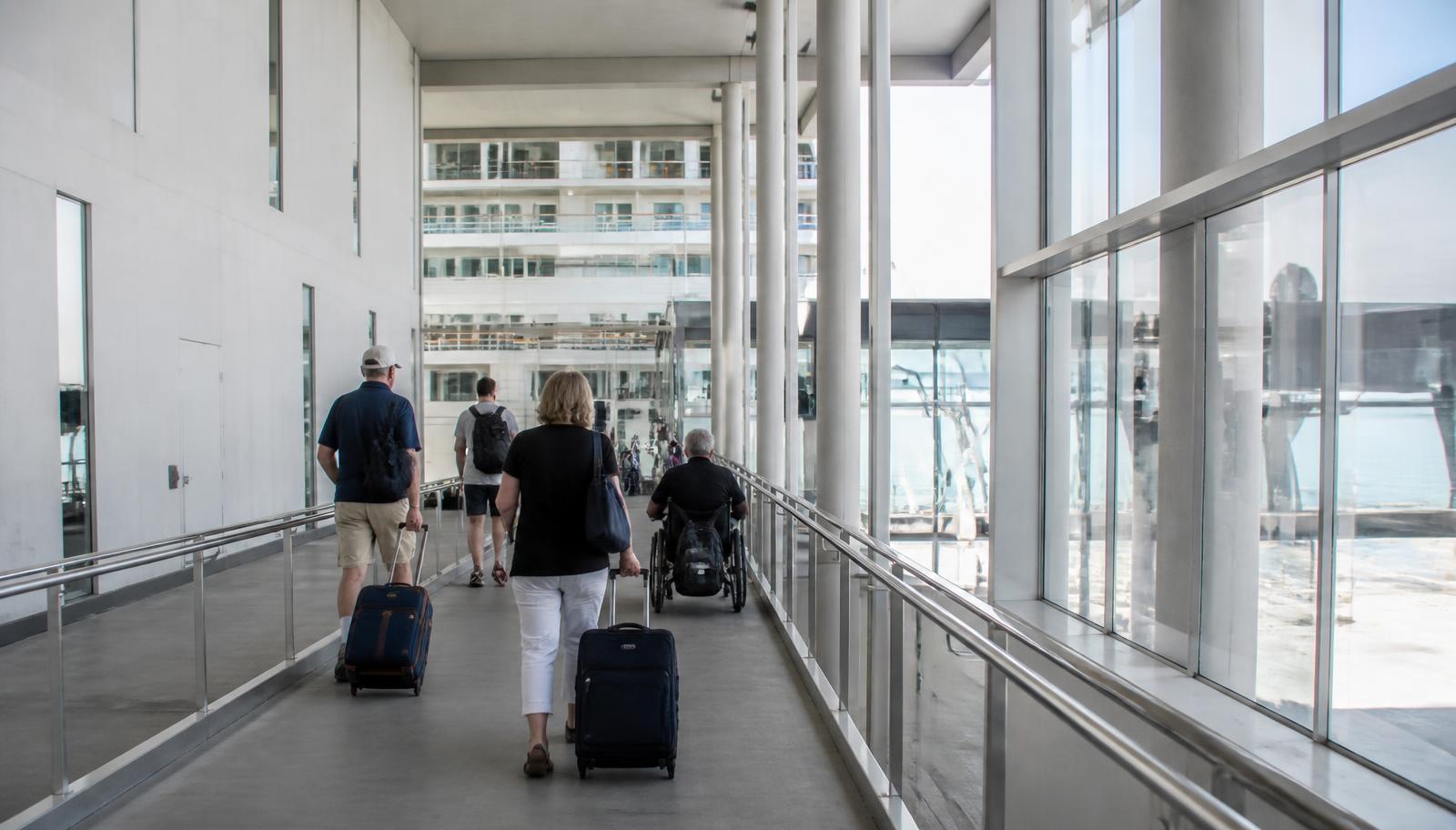
- Cruise lines are generally far more generous than airlines, but if you fly to the port the airline's limits govern. Luggage is normally handed over at the terminal and delivered to the cabin later, so anything needed for the first hours belongs in a hand bag. Certain items are prohibited on board, typically including irons, heating elements and, on many lines, alcohol brought aboard.
- Money ashore
- The ship runs a cashless onboard account in a set currency; ashore you are in the local economy and may want local cash for small purchases and tenders.
Onboard internet and maritime phone rates are covered on life onboard.
Where the answer lives
Who to ask for your own case
Visa rulings, medical advice, insurance terms and operator policy are decided elsewhere, and each source publishes for your exact circumstances.
Your government
Travel advice, passport validity and which authorisations you need.
The destination authority
Visa and entry rules for each country on the itinerary.
The cruise line
Document requirements, accessibility, age rules and onboard policy for the specific sailing.
Your insurer and clinician
Policy wording, cover for your regions, vaccinations and medication.
Continue