Before you book
How cruises work
A cruise is a scheduled voyage on a passenger ship that visits a sequence of ports.
The short answer
One ship provides the accommodation, most of the meals and the transport between destinations. That single fact is the structural difference between a cruise and a land-based multi-city trip, and it explains most of what follows.
The voyage runs from a departure port through a series of port calls and stretches of open water, and ends either back where it started or at a different port.
The operating model
The shape of a voyage
Every cruise is built from the same five moments, repeated as many times as the length of the sailing allows.
Day one
Departure
Boarding takes place at the terminal and the ship sails later the same day.
Under way
Sailing
The ship covers the distance to the next port, often overnight.
In port
Port call
The ship is alongside or at anchor for part of the day and passengers can go ashore.
Repeat
Sailing
The pattern repeats for the number of nights the itinerary covers.
Final morning
Return or final port
The voyage ends back at the departure port or at a different one.
The itinerary decides almost everything else
Which days are port days, how long you have ashore, how much time is spent under way and where the voyage ends are all set by the published route, not by the ship.
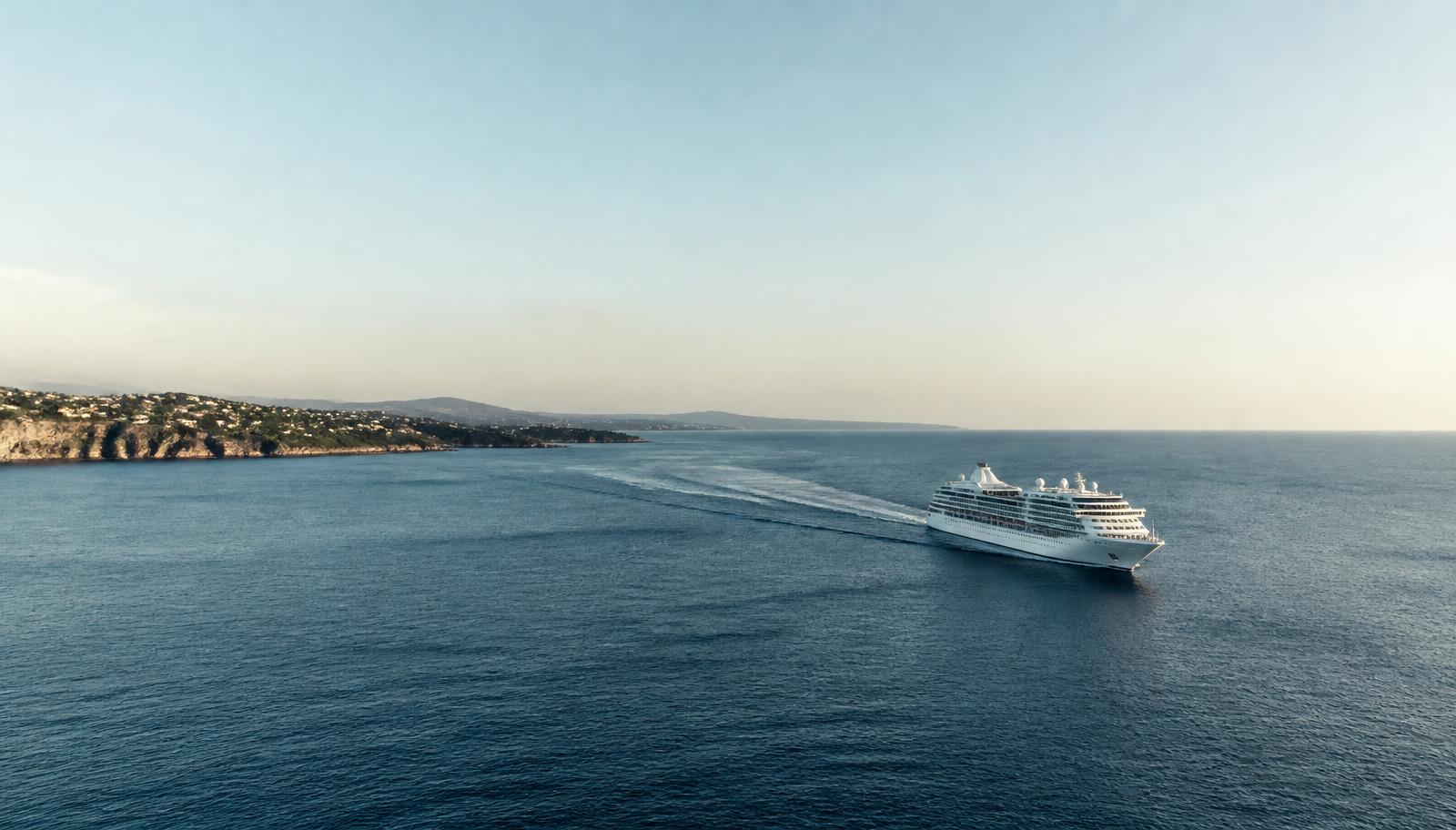
The two kinds of day
Port days and sea days
Whether a given day is spent alongside or under way is the single biggest thing that changes it.
Alongside or at anchor
A port day
- The ship is at a quay, or anchored off a port, for part of the day.
- Passengers can go ashore and must return before the published all-aboard time, which is earlier than the departure time.
- At a tender port the ship anchors offshore and small boats carry passengers ashore. That transfer takes time in each direction and can be curtailed in poor weather, so a tender call is less certain than a docked one.
Under way
A sea day
- The ship is under way for the whole day and everybody is on board at once.
- Sea days exist because of distance between ports rather than as filler.
- They are also why itineraries in wide-open regions have fewer stops than itineraries in dense ones.
How those days are sequenced into a route — round-trip or one-way, how many sea days, how the season changes it — is covered in how cruise itineraries work.
Mechanics
Three things that follow from a hotel that moves
The ship has to be somewhere else by morning, and everything below is a consequence of that.
- Day one is not a port day
- The first day is spent joining the ship rather than visiting anywhere. Boarding runs across a window rather than at a single time, cabins may not be ready when you step aboard, luggage is handed over at the terminal and delivered later, and a safety drill is required before or shortly after departure. Treat the departure day as travel time, not as a day in the departure city — unless you arrive a day early and make it one.
- The distance is covered while you are on board
- A ship moves at sea speed, so legs between ports are commonly run overnight or across part of a day. That is why a route with widely spaced ports produces sea days: the time has to come from somewhere, and the only place it can come from is the part of the day you are not ashore.
- Scheduled port time is longer than usable time ashore
- The published window runs from arrival to departure, but the ship has to berth and clear before anyone lands, the all-aboard time falls before departure, and at a tender port the transfer consumes time in each direction. The berth may also sit some distance from the place the call is named after. Time ashore is what remains after all of that.
On board and ashore
What the days themselves run on
Once the ship sails, the pattern repeats, and a small number of arrangements govern it.
- The daily programme
- A programme lists what is happening and when, alongside venue hours and the next day's port timings. Meals run at set times in the main dining rooms and continuously in the buffet.
- The ship's clock
- Ship time, not local time, governs everything on board — including when you must be back on board.
- Going ashore
- In each port you can join an excursion sold by the cruise line, arrange something independently, or walk off and explore where the terminal allows it.
- Who carries the risk
- Passengers on the line's own excursions are accounted for by the ship; independent arrangements are your own responsibility. All-aboard times are published and enforced.
- Documents
- Requirements depend on your nationality and on the countries the itinerary visits, so they are confirmed with the operator and the relevant authorities rather than assumed.
- The final morning
- Onboard accounts are settled before disembarkation, and arrival and clearance times can shift — which is why onward travel is normally planned with a margin.
Where cost fits in
Much of this is in the fare, and some of it is not
Where the line between included and extra falls varies by cruise line and fare type, which is why two headline fares are rarely comparable on their own.