Before you book
How cruise itineraries work
An itinerary is the published sequence of ports and sea days for one sailing.
The short answer
Two cruises to the same region can be very different documents. The route shape, the balance between port days and sea days, the amount of usable time in each port and whether the ship docks or tenders are all set out in the itinerary.
Read in that order, a published route stops being a list of place names and becomes a description of the week.
The first distinction
Round-trip and one-way
Both patterns exist in most regions, and the choice changes your travel arrangements as much as the sailing.
Closed-loop
Round-trip
- Starts and ends at the same port.
- Simplifies travel because you need one set of flights to and from one city.
Open-jaw
One-way
- Starts at one port and finishes at another.
- Often covers more ground, but needs flights into one city and out of another, which changes the cost and complexity of the trip.
In Alaska, for instance, the distinction between a round-trip Inside Passage sailing and a one-way Gulf of Alaska sailing is one of the first things to settle — see the Alaska region page.
What a route looks like
Reading the sequence
The two models below are explanatory patterns, not bookable sailings. They show the shapes you will recognise once you start comparing published routes.
A round-trip week in a dense region
Explanatory pattern only. Ports close together allow consecutive port days.
- Day 1DepartureBoarding at the gateway port
- Day 2PortDocked call
- Day 3PortTender call, shorter usable time ashore
- Day 4SeaLonger leg between clusters of ports
- Day 5PortDocked call
- Day 6PortDocked call
- Day 7ReturnBack at the departure port
A one-way route across a wide region
Explanatory pattern only. Distance between ports produces more time under way.
- Day 1DepartureBoarding at the first gateway
- Day 2SeaFull day under way
- Day 3ScenicScenic navigation without going ashore
- Day 4PortDocked call
- Day 5SeaFull day under way
- Day 6PortDocked call
- Day 7Final portDisembarkation at a different city
Sea days are structural, not filler
The number of sea days follows from the distances involved. Regions with widely spaced islands or long coastal legs need more time under way; densely packed areas allow more consecutive port days. Comparing two itineraries of the same length, the port-to-sea ratio tells you a lot about how the week will feel.
Ports of call
What a port call actually gives you
Itineraries list arrival and departure times for each port. The usable time ashore is always shorter than that window.
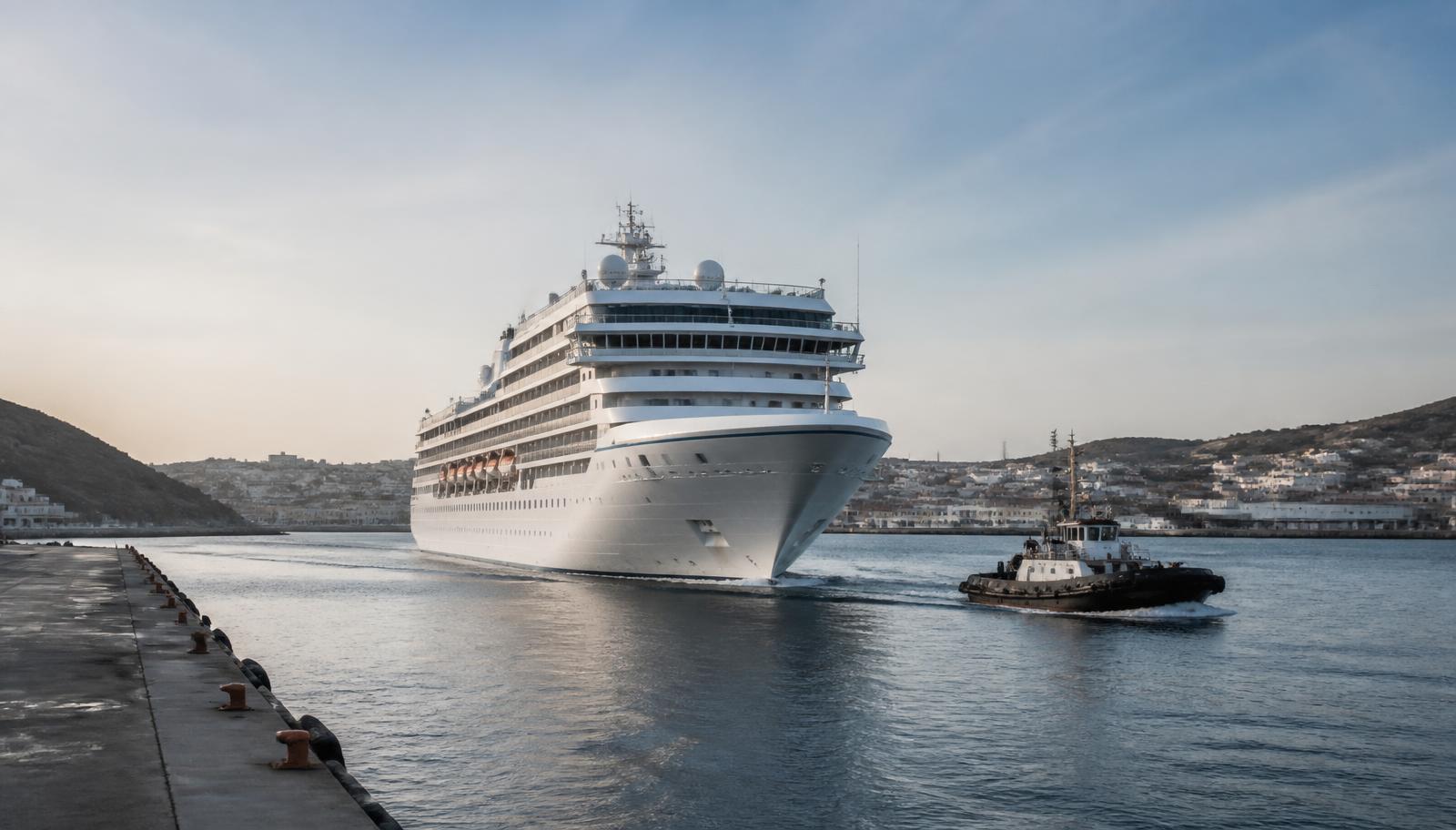
- The all-aboard time
- You have to be back on board before it, and it falls earlier than the published departure time. A long list of ports is not the same as a lot of time in them.
- Docked or tendered
- At a tender port the transfer in each direction consumes more of the day, so check whether the ship docks or tenders as well as where it calls.
- The name versus the port
- An itinerary is often marketed by the famous place near the port rather than by the port itself, and the two can be an hour or more apart — the commercial harbour serving a city, or an island's only deep-water quay some distance from the town people picture.
- Recurring shapes
- Within a region, sailings tend to fall into a handful of repeating shapes: a short loop of three or four nights, a week calling at four or five ports, a longer route reaching the far end of the region, and a one-way route paired with its mirror image in the opposite direction.
- Overnight and late calls
- Some itineraries hold the ship in a port overnight or until late evening instead of sailing in the afternoon. That single scheduling decision changes what the call can contain — an evening ashore, a place further inland, an event that only happens after dark — and it costs the route distance elsewhere, usually a port or a longer leg at sea.
- Scenic cruising
- A stretch listed as scenic cruising is a passage the ship makes slowly for the view — a fjord, a gorge, a channel, an ice-filled bay — without anyone going ashore. It occupies the same slot as a port call in the published route, so a day that looks empty may be one of the more distinctive parts of the voyage, and a balcony or open deck matters more on it than on other days.
Count usable hours ashore, not the number of ports
Between two seven-night sailings, the one with more names on the list is not necessarily the one with more destination in it. Short windows, tender calls, berths far from the town, an early all-aboard and a sea day placed where a call could have been all reduce time ashore; an overnight call or a long docked day increases it. The arrival and departure times printed against each port are what make that comparison possible.
Season
Ships move, so itineraries appear and disappear
A region's itineraries exist only while ships are deployed there.
When the season ends, a ship sails to its next region, and that transfer is sold as a repositioning cruise: a one-way voyage, often longer, with more sea days and a different balance between travelling and calling in. Shoulder weeks at either end of a season may also have fewer sailings and a reduced choice of ports.
A plan, not a promise
Why itineraries change
Published itineraries are subject to change.
Weather, sea state, port congestion, technical issues, local restrictions and operational decisions can all lead to a call being shortened, substituted or skipped, and cruise contracts generally reserve that right. A named port of call is part of a published plan rather than a guaranteed element of the trip. For an actual itinerary, check the cruise line's own listing for the ship and date concerned.