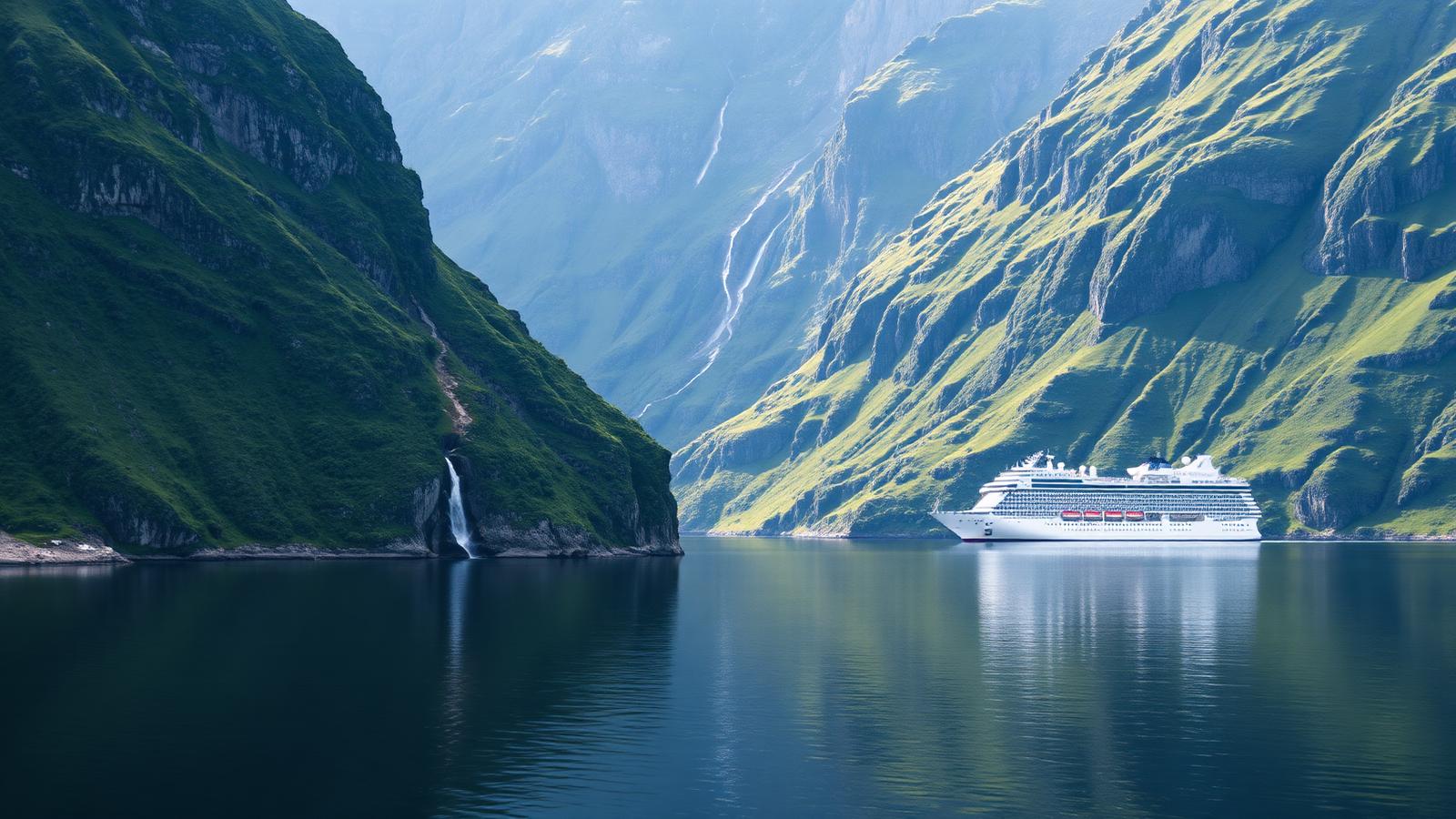
The scenery happens while the ship is moving
Fjords such as the Geirangerfjord are reached by sailing inland for several hours. The navigation itself is the attraction, so time on deck during transit matters as much as time ashore.
Ocean cruise region
Cruising in Norway means sailing inland. Ships leave the open sea and move slowly along narrow fjords with mountains on both sides, so a large part of the day is spent navigating rather than alongside a quay.
The fjord coast runs for well over a thousand kilometres, and cruise itineraries usually cover only part of it. The western fjords between Stavanger and Ålesund are the core: this is where the Geirangerfjord, the Sognefjord and the Nordfjord cut deep inland, and the stretch that one-week western fjord itineraries are generally built around.
Going further north is a different trip. Tromsø and the North Cape lie hundreds of nautical miles beyond the western fjords, so Arctic itineraries are longer, include genuine sea days and run over a shorter part of the year.
At a glance
The structural facts first, in the order that makes a fjord itinerary readable.
What makes this region different
In most cruise regions the ship moves at night and the port is the day. Here the fjord transit is scheduled daytime, so the route itself is a large part of what you are looking at.
Fjords such as the Geirangerfjord are reached by sailing inland for several hours. The navigation itself is the attraction, so time on deck during transit matters as much as time ashore.
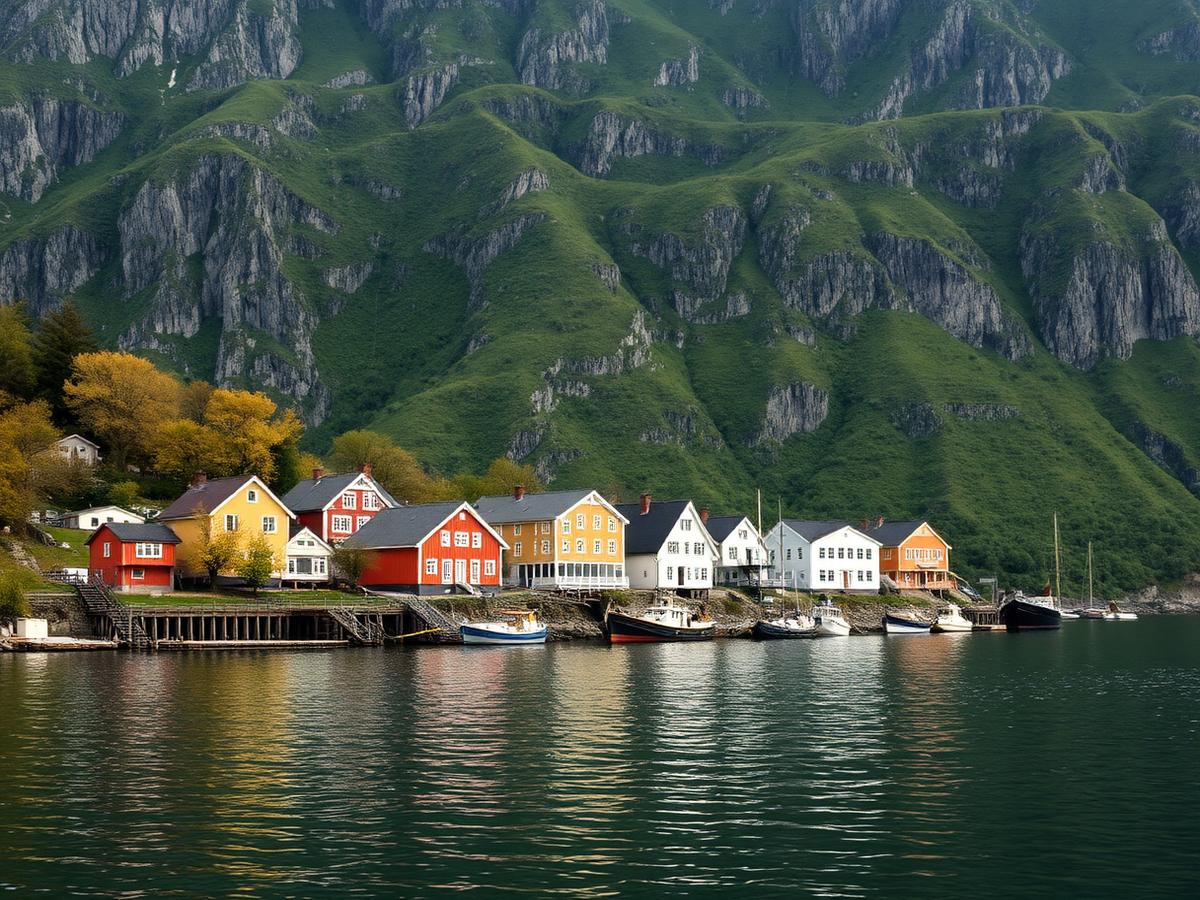
Places such as Geiranger, Flåm and Olden are villages, not cities. Some calls are at anchor with tender transfer, and the number of ships a fjord village can take at once is limited.
Unlike most European cruise regions, a fjord itinerary can stay within a single country for its whole length, apart from the gateway at either end.
Itineraries beginning in Amsterdam, Kiel, Copenhagen or a UK port include a North Sea crossing at each end. Those crossing legs reduce the number of days available on the Norwegian coast within the same cruise length.
Ships either start in Norway — usually Bergen, sometimes Oslo or Stavanger — or arrive from a northern European gateway such as Copenhagen, Kiel, Amsterdam or Southampton. That choice decides how much of the cruise is spent in the fjords and how much is spent crossing the North Sea to reach them.
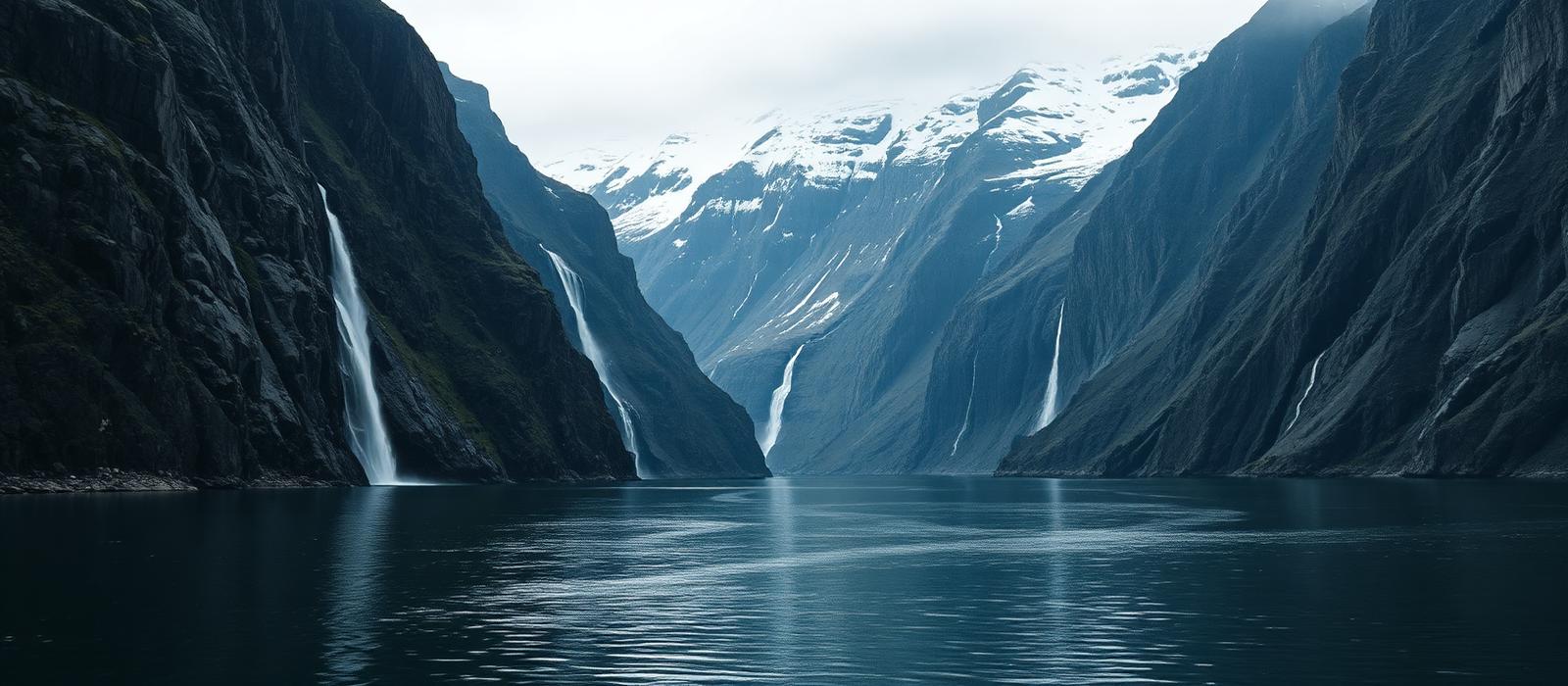
A fjord is a long, narrow inlet cut inland by ice and later flooded by the sea. The interesting part is usually at the far end, which means a ship that wants to reach it has to sail a long way in and then the same way back out again. The water is deep enough for large ships, but the channel is confined, so the transit is slow and it is done in daylight on purpose.
That geometry is what limits the port count. A single inner-fjord call can occupy most of a day once the inbound and outbound transits are counted, so a week on the Norwegian coast holds fewer places than a week in the Mediterranean covering the same nautical distance. The compensation is that the hours between the calls are the attraction rather than dead time.
It also explains the shape of the settlements you stop at. There is little flat land at the foot of a fjord wall, so the communities are small, the quays are short and the number of ships that can be accommodated at once is limited. Where no berth exists, passengers go ashore by tender, which again costs time and is more weather-dependent than a berth.
| Sailing distance to reach it | What the days consist of | Season behaviour | |
|---|---|---|---|
| Western fjords | Reachable within a short cruise from a Norwegian gateway; a North Sea crossing if the ship starts elsewhere. | Daytime fjord transits with small-community calls at the head of the inlets. | The longest usable season of the three stretches. |
| Southern Norway | Closest to the North Sea gateways and the shortest to add to a route. | Larger coastal towns and more conventional port days than inner-fjord sailing. | Also served outside the peak fjord months as part of wider northern-Europe routes. |
| Arctic Norway | A long coastal run north; itineraries are correspondingly longer. | Extended open-coast sailing between widely separated calls. | Narrowest window, and the stretch where daylight changes the trip most. |
Map
Switch between cruise areas, ports, departure gateways and cruise-line presence. Areas are geographic stretches, not itineraries. Everything on the map is also listed in text on this page.
The main geographic divisions of the region.
Three parts of the coast
The Norwegian coast is long enough that a single cruise covers part of it. These three stretches behave differently, and each is explained once here — with its cruise pattern and its ports together.
The fjord coast between Stavanger and Ålesund, where ships leave the open sea and sail inland along narrow, steep-sided inlets such as the Geirangerfjord and the Sognefjord branch to Flåm.
Cruise pattern: Short sailing distances but slow navigation: much of the day is spent moving through a fjord rather than at a berth, so scenic cruising is part of the itinerary rather than an extra.
Bergen
Turnaround and call
The main turnaround port of the Norwegian fjord coast and the usual start or end point for western fjord itineraries.
Stavanger
Turnaround and call
A southern fjord-coast port with berths close to the old town, also used as a turnaround port by some operators.
Ålesund
Port of call
A coastal town port that serves as the sea access point for the Geirangerfjord area and the surrounding Sunnmøre coast.
Geiranger
Port of call · Geirangerfjord
An anchorage call at the head of the Geirangerfjord, part of the UNESCO-listed West Norwegian Fjords; passengers usually come ashore by tender.
Flåm
Port of call
A small village berth at the inner end of the Aurlandsfjord, reached after several hours of navigation inside the Sognefjord system.
Olden
Port of call
An inner-fjord call in the Nordfjord, used as the access point for the Jostedalsbreen glacier area.
The approach from the Skagerrak into southern Norway, including Kristiansand and the long Oslofjord up to Oslo. Many fjord itineraries begin, end or call here on the way to or from northern Europe.
Cruise pattern: City and coastal calls rather than fjord scenery; this area mainly functions as the link between the fjords and northern European gateways.
Oslo
Turnaround and call
The Norwegian capital, at the head of the Oslofjord, used both as a call and as a turnaround port.
Kristiansand
Port of call
A southern coastal city port often called on the leg between northern Europe and the fjords.
The coast north of the Arctic Circle, from Tromsø to the Nordkapp plateau near Honningsvåg. Reaching it requires long open-sea legs, so these itineraries are longer than a standard fjord week.
Cruise pattern: Fewer, longer-spaced ports and real sea days between them, with continuous daylight around midsummer and a much shorter operating season than the western fjords.
Tromsø
Turnaround and call
The largest city north of the Arctic Circle in Norway and the main port of Arctic Norway itineraries.
Honningsvåg
Port of call · North Cape
The port on Magerøya used to reach the Nordkapp (North Cape) plateau, at the northern limit of mainland Norway.
Where the cruise starts
The single decision that changes a fjord cruise most is whether the ship begins on the Norwegian coast or has to cross the North Sea to reach it.
The ship stays on the Norwegian coast for the whole cruise, giving the highest ratio of fjord days to sea days. Requires a flight into Norway.
Departing from Amsterdam, Kiel, Copenhagen or a UK port, with a North Sea crossing at each end and Norwegian calls in between. How many Norwegian calls fit depends on the length of the cruise.
A longer sailing that continues past the western fjords to Tromsø and Honningsvåg, with open-sea legs between the far-northern ports.
In most cruise regions the ship moves at night and you see places by day. Here, the fjord transit is a scheduled part of the daytime programme, and the itinerary is planned around it.
The western fjords and Arctic Norway are separated by a long stretch of open coast. A one-week cruise realistically covers one of them, not both.
Fjord villages have far less capacity than a city port, and Norwegian authorities regulate emissions in the World Heritage fjords. Which ships can call where is shaped by this, not only by commercial choice.
Large-ship mainstream
Big ships running fixed summer rotations, mostly from northern European gateways, calling at the fjord ports that can take their size.
Premium mid-size
Smaller ships operating on the same coast, often on longer itineraries that continue to Arctic Norway.
Expedition overlap
Some operators market small-ship voyages along the same coast with an expedition framing. Those voyages sit outside the ocean-cruise model used on this page.
Season and conditions
A short season built around the northern summer, longest in the south.
The widest choice of sailings is between May and September, when daylight is long and the inner fjord ports are fully served.
Arctic itineraries to Tromsø and the North Cape are concentrated even more tightly around midsummer, when there is continuous daylight above the Arctic Circle.
A limited winter programme exists in northern Norway around the aurora season, but it is a different product from the summer fjord cruise and is offered by far fewer operators.
| Month | Cruise activity |
|---|---|
| Jan | Low season |
| Feb | Low season |
| Mar | Low season |
| Apr | Shoulder period |
| May | Peak cruise activity |
| Jun | Peak cruise activity |
| Jul | Peak cruise activity |
| Aug | Peak cruise activity |
| Sep | Shoulder period |
| Oct | Low season |
| Nov | Low season |
| Dec | Low season |
Indicative pattern for the region as a whole. The western fjords carry the bulk of the season; Arctic Norway is narrower still, and winter activity is a small, specialised programme rather than general fjord cruising.
Cool and changeable maritime weather, with high rainfall on the western coast and long summer daylight.
Norway is warmer than its latitude suggests, because the coast is washed by water carried up from the Atlantic. What the latitude does control is light. In summer the days are extremely long, and north of the Arctic Circle the sun does not set at all for part of the season; in winter the same geography removes the daylight almost entirely.
For a region whose product is scenery seen from the ship, that is decisive. Long days mean a full fjord transit can be sailed in the light, with the mountains visible from early morning to late evening. It is the reason the main season is concentrated in the summer months rather than spread across the year, and the reason northern itineraries feel different from southern ones in the same week.
The dark half of the year is not empty, but it is a different product: shorter coastal sailings where the attraction is the winter sky rather than the fjord walls. Those depend on clear conditions and are aimed at a different kind of trip, which is why they are not simply the summer itinerary in colder weather.
What to compare
We do not know what is available and do not recommend an itinerary. These are the factual differences to read for once you start looking at specific sailings elsewhere.
Cruise-line presence
Listed alphabetically from each line's own published destination information. No ranking, scoring or recommendation. Full profiles live on the cruise lines page rather than being repeated here.
Practical orientation
High-level orientation, not a destination guide. For passport, visa, health and security requirements, use the official source for your own nationality.
Where to go next
Norway sits inside a larger system of ocean, river and expedition cruising.
Facts on this page are taken from the sources below. Cruise lines are used only as sources for facts about their own operations, never as sources of independent assessment.