Itineraries
What is a repositioning cruise?
Cruise ships follow the seasons. The voyage that carries a ship from one season's region to the next is sold as a cruise in its own right — and it rewards a different kind of traveller than a week in the Caribbean does.
The short answer
A repositioning cruise is a one-way voyage that moves a ship from the region where it spent one season to the region where it will spend the next — for example from the Caribbean to the Mediterranean or Northern Europe in spring, and back again in autumn.
It suits someone who wants the ship and the ocean to be the holiday, who has more days to spend than a standard week, and who can arrange and pay for a one-way flight home. It suits that person better than it suits someone chasing a specific island, a tight schedule, or the lowest total cost of a trip — because the advertised fare is only one layer of what a one-way, cross-ocean cruise actually costs to complete.
By The SnapVoyages TeamPublished October 2026
The cause
Why ships reposition at all
A ship is a fixed, extremely expensive asset that earns only when it sails where people want to cruise. Demand in most regions is seasonal, so the fleet moves with it.
Alaska and the Norwegian fjords are summer destinations, closed to mainstream cruising for most of the winter; the Caribbean is busiest in the northern winter; the Mediterranean runs a long season but still peaks in summer. A cruise line that wants to keep a ship earning year-round has to move it between these regions as the seasons turn, and the transfer voyage itself is sold to passengers rather than sailed empty. Norwegian Cruise Line describes this plainly: ships relocate "to match seasonal travel demand," typically once or twice a year, in spring or autumn. The seasonal windows behind this are mapped in when is cruise season around the world.
It is worth being precise about scale. CLIA's most recent industry report puts the Caribbean as the single most-visited cruise destination worldwide, taking 44% of all 2025 ocean-going passengers, with the Mediterranean the clear second and Alaska a much smaller, firmly seasonal market. That imbalance — one huge, mild, year-round-friendly region and several smaller, weather-limited ones — is a large part of why so much repositioning in the industry flows between the Caribbean and Europe, and between the US West Coast and Alaska.
Not every ship repositions every year. Some stay in one region, and a line's deployment plan can change between seasons as demand shifts. A repositioning voyage exists only where an operator has actually scheduled one for that ship, that year — it is never a fixed feature of a season.
Seasonal movement
The usual direction of travel
The pairings below are the broad seasonal logic described by cruise lines' own route information. They are patterns, not timetables: any single ship's actual route and dates are set by its operator and published closer to the sailing.
Winter season
Caribbean
→ transatlantic, spring →
← transatlantic, autumn ←
Summer season
Mediterranean / Northern Europe
Winter season
US West Coast / Mexican Riviera / Hawaii
→ Pacific coastal, spring →
← Pacific coastal, autumn ←
Summer season
Alaska
Winter season
Caribbean / Florida
→ via the Panama Canal →
← via the Panama Canal ←
Summer season
Alaska / US West Coast
Winter season
Southern Hemisphere (Australia, South America)
→ long ocean passages →
← long ocean passages ←
Summer season
Northern Hemisphere regions
Schematic of the seasonal logic, not a map or a schedule. Individual ships follow their operator's deployment, which changes from year to year.
Three repositioning patterns actually in use
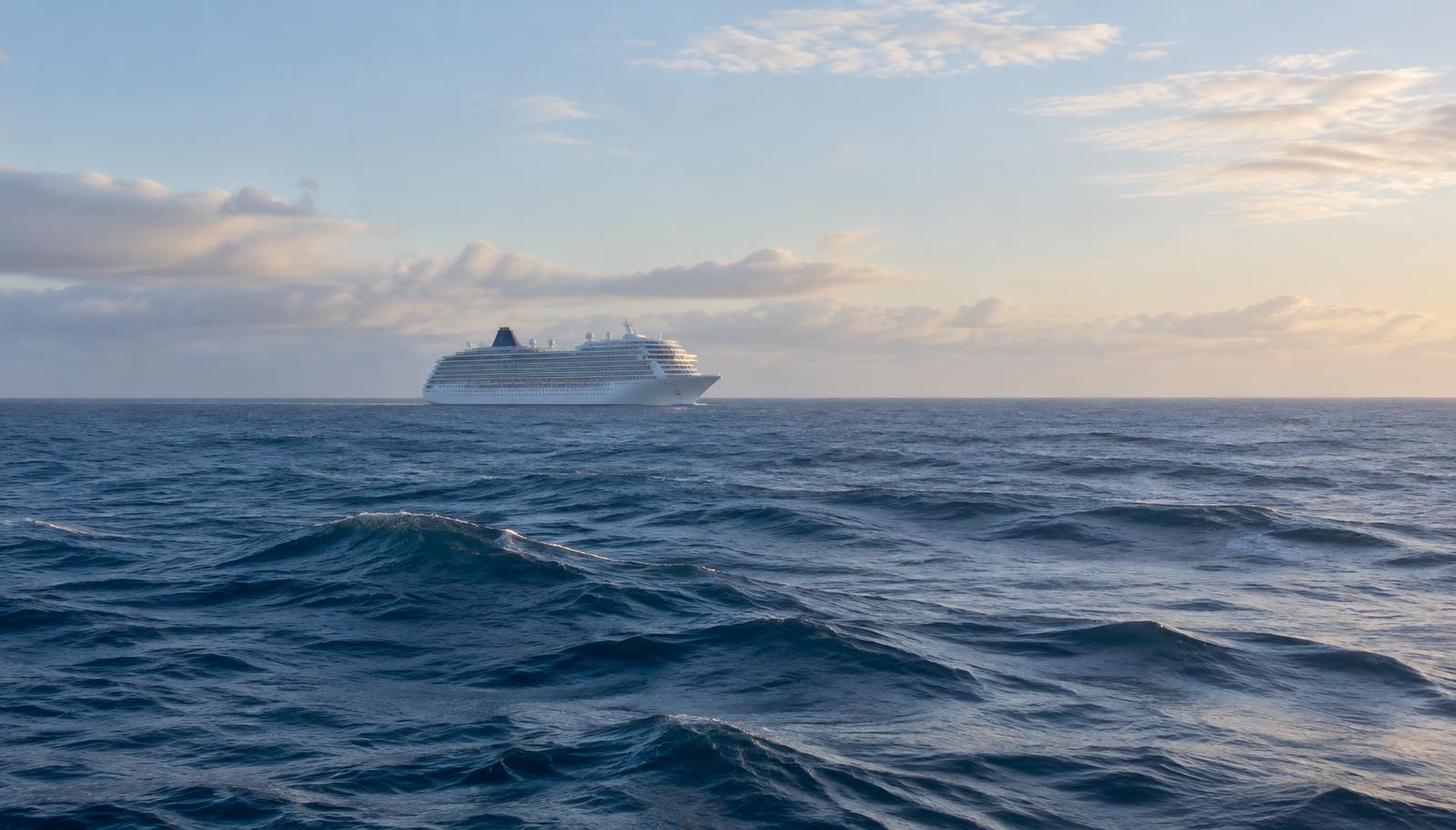
Transatlantic crossings move ships between North America and Europe, usually calling at one or two ports near each coast and otherwise crossing open ocean. Cunard's Queen Mary 2 is unusual in running these as a standing, nearly year-round 7-night service between New York and Southampton rather than a once-a-season repositioning; most other lines' transatlantic sailings are the seasonal repositioning itself, longer, and offered only around the spring and autumn changeover.
Panama Canal repositionings move ships between the Caribbean/Atlantic side and the Pacific coast (Alaska, Mexican Riviera, Hawaii) by transiting the canal itself, usually with a run of Central American or Mexican ports either side of the transit day. Celebrity Cruises, for example, markets these explicitly as one-way sailings between Florida and California.
Long ocean passages, most often connecting a Southern Hemisphere season (Australia and New Zealand's summer, South America) to a Northern Hemisphere one, exist but are rarer and run on a much thinner schedule, since far fewer ships work both hemispheres in a single year.
Side by side
How it differs from a round-trip cruise
| Typical round-trip cruise | Repositioning cruise | |
|---|---|---|
| Route shape | Starts and ends in the same port | Starts in one region and ends in another, often on another continent |
| Sea days | Mixed with port days through the week | Often several consecutive sea days, especially across an ocean |
| Length | Commonly around a week | Often 10–20+ nights, because the distance is fixed by geography |
| Ports | Chosen to suit the region | Grouped near the start and end, with fewer, or none, in the middle |
| Return journey | Usually back to the same airport | One-way: the return is a separate journey you arrange and pay for |
| Frequency | Repeated throughout the season | Typically once or twice a year per ship, at the season change |
| Fare behaviour | Set by regional peak-season demand | Often priced to help fill a voyage the line must sail anyway; whether a given sailing is actually cheaper can only be checked on the fare itself |
An ocean crossing cannot be shortened by itinerary planning
A round-trip itinerary can add or drop a port. A transatlantic or Panama Canal repositioning has to cover a fixed distance, so the sea days are structural, not a scheduling choice.
What the days actually look like
A high proportion of sea days, and what that means in practice
A transatlantic crossing of around seven nights, in Cunard's own routing, typically has no port calls at all between the two coasts. Longer repositioning routes add a handful of ports near one or both ends, but the middle of the voyage is still open ocean.
- Typical crossing length
- Roughly 7 nights, coast to coast, on a direct transatlantic
- Longer repositionings
- 10–20+ nights, when ports are added near each end
- Port rhythm
- Clustered near departure and arrival, largely absent in the middle
- On-board pace
- No excursions to plan for days at a stretch; the ship's own programme fills the day
Consecutive sea days change the texture of a cruise rather than its safety: nothing about sailing open ocean for several days is itself hazardous on a modern cruise ship, but it is a very different rhythm from a week that alternates a port with a day at sea. There is no daily disembarkation to plan around, no excursion to book, and the ship's own programme — dining, entertainment, lectures, deck time — becomes the main structure of the day. For some travellers that is the entire appeal; for others, several days with no port in sight is the reason to avoid this kind of cruise.
Itinerary intensity is also lower in the sense that matters to a traveller comparing trips: fewer destinations are visited per day of travel. A 14-night transatlantic repositioning might include two or three ports in total; a 14-night round-trip Mediterranean cruise might include ten. That is not a flaw in the repositioning cruise, it is the trade a traveller is making — ocean days and a longer trip, for fewer but often more unusual ports, since a repositioning can call at places that do not fit a normal regional loop.
Money
The low advertised fare versus the full cost of the journey
A repositioning cruise can carry a genuinely different per-night fare from a regional sailing, because the line is moving the ship either way and wants cabins filled. That fare is still only the first layer of what the trip costs to complete.
Layer 1
The advertised cruise fare
Covers the cabin, meals in included venues and the ship's standard programme — the number shown in search results and the one repositioning sailings are most often discounted on.Layer 2
Outbound travel to the departure port
A flight, train or drive to whichever continent the voyage starts on — potentially a long-haul flight, since repositioning departure ports are set by where the ship's previous season ended.Layer 3
The one-way return flight
This is the layer that most changes the arithmetic. A one-way international flight booked separately is frequently priced well above half of an equivalent return fare, and it has to be bought and timed around the ship's actual arrival.Layer 4
Pre- or post-cruise nights
A buffer night (or several) at the start and end, so a delayed flight does not risk missing embarkation, and so disembarkation is not rushed straight to an airport.Layer 5
On-board spending and gratuities
The same categories as any cruise — drinks, specialty dining, Wi-Fi, service charges, excursions at the ports that are visited — now spread across more days at sea, where on-board spending for some travellers tends to be higher simply because there is more time on the ship.
None of these layers has a universal number: fares, flight prices and a line's own charges change constantly and depend on the route, the season and how far ahead you book. The useful discipline is the comparison itself — adding layers 2 through 5 to the advertised fare before judging whether a repositioning cruise is actually the cheaper way to make a particular journey, rather than comparing its headline fare with a round-trip cruise's headline fare. The general structure of a cruise's full cost, including charges that apply to every sailing, is set out in what does a cruise really cost.
Illustrative examples
Two travellers, two different answers
Hypothetical plans, not documented bookings. They show how the same style of cruise can be a strong fit or a poor one.
Hypothetical A
The retired couple with time to spend
- Who this is
- Recently retired, no fixed work calendar, comfortable spending two to three weeks away rather than one.
- The plan
- Books a 14-night transatlantic repositioning from Florida to Southampton in April, flies home from London a week after disembarking, having added a short land stay.
- Why it fits
- Sea days are not a cost to them, they are the point: time to read, use the ship's facilities and not plan a daily excursion. The one-way flight home is a minor addition against a trip of this length, and the fare itself may undercut an equivalent-length round-trip Caribbean cruise.
- What to watch for
- They should still confirm the ship's own itinerary-change and refund terms, check what their travel insurance covers for a one-way international trip, and budget the return flight and any pre-cruise night as real costs, not afterthoughts.
Hypothetical B
The family with one week and a fixed return flight
- Who this is
- Two adults and two school-age children, one week of school holiday, return flights already booked to a single home airport.
- The plan
- Considers a 10-night Panama Canal repositioning from Florida to California because the per-night fare looks attractive.
- Why it fits
- The length alone rules it out before price does: the voyage runs three to four nights longer than the holiday allows, and a one-way flight from the West Coast to replace an already-booked return ticket would likely erase any fare saving.
- What to watch for
- A better fit for this family is a round-trip cruise of matching length from a single port, or waiting for a repositioning that falls entirely inside the available week — which the pattern in this guide shows is unlikely for a Panama Canal transit.
Weighing it up
Advantages and disadvantages
What can work in its favour
- Time at sea without port-day pressure, for readers who want the ship and the ocean itself to be the holiday.
- Ports at both ends, and sometimes along the way, that a single-region cruise would not combine — a repositioning can be the only way to reach certain combinations of places by ship.
- Operators sometimes price these voyages to help fill a sailing they must run regardless; whether that applies to a given sailing can only be checked on the fare itself.
- A one-way trip can be combined with time on land at either end, turning the cruise into one leg of a longer journey rather than the whole of it.
What can work against it
- Many consecutive sea days, which some travellers find long rather than restful.
- Open-ocean weather: a crossing in the shoulder season, especially a late-autumn North Atlantic transatlantic, can be rougher than a coastal cruise.
- A one-way flight home, which can cost more than a return and must be booked, timed and sometimes insured separately from the cruise.
- Fewer ports per day of travel, and a longer total time away than a comparable round-trip cruise.
Before you book
Logistics that change with a one-way voyage
- Two airports, two countries
- You fly into one continent and out of another. Compare the total journey, not just the cruise fare, and check whether either airport adds a connecting flight you had not budgeted for.
- Documents for both ends
- Entry rules apply at the arrival country as well as the departure country, and they can differ for a cruise arrival versus a flight arrival. The operator and the relevant governments are the authority, not a travel blog.
- Time zones at sea
- Clocks change on board as the ship crosses time zones, often an hour on several different nights during an ocean crossing — not all at once at the start or end.
- Seasonal weather at both ends
- A spring transatlantic departing the Caribbean in April and arriving in Northern Europe can run through genuinely different weather at each end of the same voyage, and the North Atlantic itself is more prone to rough weather in the shoulder seasons than in high summer.
- Port availability and routing
- Because the route is fixed by the ship's need to get from region A to region B, repositioning itineraries sometimes include ports a round-trip cruise from either region would never visit — a genuine opportunity, but one set by geography rather than by a themed itinerary.
- Total cost
- The fare is only one layer, set out above. The full structure of a cruise's cost, including charges common to every sailing, is in what does a cruise really cost.
Reader questions
The follow-up questions
- Is a repositioning cruise always cheaper?
- Often the per-night fare is lower than a regional sailing, because the line is moving the ship anyway, but a one-way flight home and the extra nights at sea can close or reverse that saving once the whole trip is costed. Check the full journey, not just the headline fare.
- Are repositioning cruises rougher than regular cruises?
- They spend more time on open ocean, and an ocean such as the North Atlantic in the shoulder seasons can be rougher than coastal or island-hopping routes. That is a difference in exposure, not a guarantee of rough conditions on any particular sailing.
- Can I book just part of a repositioning cruise?
- Some lines sell shorter segments of a longer repositioning voyage where the ship stops at an intermediate port that is also a boarding or disembarkation point. Availability depends entirely on the specific sailing and operator.
- Do repositioning cruises run every year on the same route?
- The broad seasonal logic repeats, but the specific ship, ports and dates are set by each line's deployment plan for that year and can change. Always check the current sailing rather than assuming last year's route.
In short
A trade of time and flexibility for a different kind of trip
A repositioning cruise is not a discounted version of a regular cruise; it is a different kind of trip that happens to follow a cruise ship's own seasonal migration. The sea-day ratio is higher, the trip is usually longer, the route is fixed by geography rather than theme, and the return journey has to be planned and paid for separately. None of that makes it worse than a round-trip cruise — it makes it suited to a different traveller: one with time, a tolerance for open ocean, and a willingness to treat the whole journey, flights included, as the real cost of the trip.
Sources & verification
Seasonal patterns are drawn from cruise lines' own route descriptions and from CLIA's industry reporting, used only as sources for their own operations and published figures. The Panama Canal drought restrictions are a documented 2023 event from the Panama Canal Authority, not a standing risk level. No specific sailing, price or ship deployment for a future year is stated, because those are set by operators and change from year to year.
- Cruise Lines International Association (CLIA) — read 2026-09-01
- NOAA National Hurricane Center — Atlantic hurricane season climatology — read 2026-09-01
- Norwegian Cruise Line — "What Is a Repositioning Cruise?" — read 2026-10-10
- Norwegian Cruise Line — "Transatlantic vs. Repositioning Cruises" — read 2026-10-10
- Celebrity Cruises — Panama Canal cruises, including one-way repositioning sailings — read 2026-10-10
- Royal Caribbean International — sample repositioning cruise itinerary page — read 2026-10-10
- Cunard — Queen Mary 2 transatlantic crossings — read 2026-10-10
- Panama Canal Authority (ACP) — Advisory to Shipping on draft restrictions during the 2023 drought — read 2026-10-10
- Cruise Lines International Association (CLIA) — State of the Cruise Industry Report 2026 — read 2026-10-10