Cost
What does a cruise really cost?
The advertised figure is not the price of the trip. It is the price of one part of the trip — and which part depends on the market it is sold in.
The short answer
There is no single figure, and anyone who publishes one is publishing a snapshot that expires. A cruise's real cost is an accumulation: an advertised fare, then a set of layers added by different parties at different moments, some unavoidable, some conditional on the voyage, and some genuinely chosen.
This guide does not tell you what a cruise costs. It shows you how the number is built, who controls each layer and when each one becomes knowable — which is what you need in order to compare two quotes that were drawn at different points on the same accumulation.
By The SnapVoyages TeamPublished September 2026
The model
Cost as accumulation, not as a list
Many explanations of cruise cost are structured as checklists that end in 'add it all up'. The list is the problem: it treats seven very different things as if they were seven items on the same receipt.
They are not the same kind of thing. A port charge originates in a published tariff issued by a port authority. A service charge is an operator disclosure that the operator revises. An occupancy supplement is arithmetic, not a fee. A drinks package is a purchase. Parking at the terminal is set by a body that has nothing to do with the cruise line at all. Each one arrives from a different direction, at a different moment, with a different degree of choice attached.
So the useful question is not what does it add up to — that answer depends on a reader's home airport, party size and appetite. The useful question is what is added, by whom, and when can I know it.
What the number grows into
Each band is one layer of the commitment, in the order it usually becomes visible. The drawing shows sequence and control, not amounts — the bars are not to scale and no layer is claimed to be larger than another.
Station 0The advertised number
UnavoidableStation 1Taxes, fees and port expenses
UnavoidableStation 2Service charges
UnavoidableStation 3Occupancy arithmetic
Depends on the voyageStation 4The onboard account
Chosen by the passengerStation 5Reaching the ship
UnavoidableStation 6Protection and paperwork
Depends on the voyage
The bottom band is the figure a reader can actually compare with another voyage. The top band is the figure that was advertised.
| Layer | Who sets the amount | In the advertised figure? | When it becomes knowable | Status |
|---|---|---|---|---|
| The advertised number | The operator, revised continuously as a sailing fills | It is the headline | Visible immediately — but only for the assumptions it was built on | Unavoidable |
| Taxes, fees and port expenses | Port authorities and governments; passed through by the operator | Sometimes inside, sometimes added at checkout | At quotation, though whether it is shown inside or beside the fare depends on the market | Unavoidable |
| Service charges | The operator, revised periodically | Included in some markets and fare types, added in others | Published by the operator before sailing; the applicable amount depends on the operator's terms and the booking | Unavoidable |
| Occupancy arithmetic | The operator's fare structure | The headline assumes two sharing | Only when the booking is configured for the actual party size | Depends on the voyage |
| The onboard account | The passenger, within the operator's pricing | No | Continuously during the voyage; settled at the end | Chosen by the passenger |
| Reaching the ship | Airlines, port authorities, hotels — third parties to the booking | Only in fare types explicitly sold as air-inclusive packages | As soon as the gateway and the dates are fixed | Unavoidable |
| Protection and paperwork | Insurers and governments; sometimes required by the operator | No | At booking, once the itinerary and the operator's conditions are known | Depends on the voyage |
Station by station
Where each layer comes from
Station 0
The advertised number
A per-person figure for one cabin category, on one sailing date, under one fare code, assuming two people share the cabin.
Four independent variables are compressed into a single figure, and three of them are invisible in the headline. Change the fare code and the same cabin on the same date carries a different number with different rules attached; change the occupancy assumption and the arithmetic behind the figure changes entirely.
Why the same voyage looks different
The advertised figure is drawn where the rules require it
A great deal of the confusion in cruise pricing is not commercial. It is regulatory: the point at which the headline number is cut differs between markets.
| The rule | The effect on the advertised figure | |
|---|---|---|
| European Union | Package prices must be given inclusive of all taxes and, where applicable, all additional fees and charges — or the traveller must be told about them before the contract is concluded. | The advertised figure tends to sit closer to the mandatory total. |
| United States | The full-fare rule at 14 CFR § 399.84 requires advertised air-inclusive tour prices to state the whole price to be paid, with only certain government taxes broken out. Its subject is air transportation and air tours, not cruise fares in general. | Outside that scope, mandatory additions are commonly presented alongside the fare rather than inside it. |
| The practical consequence | Two advertised numbers for comparable voyages may be drawn at different points on the same accumulation. | Neither number is wrong; they are answers to different questions. |
This is worth stating precisely, because it is widely overstated. US law does not require cruise fares in general to be advertised inclusive of everything mandatory; the full-fare rule at 14 CFR § 399.84 governs air transportation and air-inclusive tour advertising. The EU package travel directive does require package prices to be given inclusive of taxes and, where applicable, additional fees, or the traveller to be informed of them before the contract is concluded.
The consequence for a reader is simple and unavoidable: a figure seen in one market and a figure seen in another may be measuring different portions of the same trip.
Station 1
Taxes, fees and port expenses
Government charges plus the amounts each port authority levies on the ship and its passengers.
A port charge is not an operator invention: it originates in a published terminal tariff, a binding document the port authority issues and amends. Because a voyage calls at a different set of ports from the next voyage, the total differs sailing by sailing — which is why operators state that the amount varies rather than publishing one figure.
Station 2
Service charges
A daily per-person amount covering onboard service, either prepaid, charged automatically once aboard, or already inside the fare.
Where it is not prepaid, it is applied automatically to the onboard account each day rather than requested at the end. The rate is an operator disclosure rather than a fixed industry figure, it can differ by stateroom type, and operators revise it over time — so any figure a reader finds quoted elsewhere is a snapshot of the day it was written.
Taxes and port expenses vary by sailing
Royal Caribbean states that the amount is based on several different factors and varies by sailing, rather than publishing a fixed figure. That is not evasiveness: a voyage calling at a different set of ports incurs a different set of published tariffs.
Station 3
Occupancy arithmetic
The translation between a per-person advertised rate and the per-cabin economics underneath it.
A cabin is sold once, but priced per person on the assumption that two people occupy it. One traveller in that cabin therefore does not halve the cost. Royal Caribbean states that its posted rates are based on double occupancy and that a single guest occupying a stateroom pays 200% of the category rate unless otherwise noted; other lines handle it differently, and some ships carry dedicated single staterooms priced on their own basis. A third or fourth occupant is normally priced on a different basis again, because the marginal cost of an extra body in a cabin already sold is not the cost of the cabin.
Occupancy is the layer that surprises people most, because it does not look like a cost at all — nothing has been added, and yet the total has moved. The cause is that the advertised figure is a per-person expression of a per-cabin product. The cabin is sold once. Splitting its price between two people is a convention, not a physical fact, and when only one person occupies it the convention has to be replaced by something else.
The arithmetic varies by operator, ship, cabin and fare structure. Where a line publishes its rule, read that rule rather than assume an industry average — there is no industry average worth quoting.
Station 4
The onboard account
A shipboard account, opened against a card or a cash deposit, through which everything bought aboard settles.
The mechanism matters more than the menu. Many onboard purchases are posted to a shipboard account rather than settled individually at the point of sale, so spending is recorded rather than felt, and the total surfaces once at the end of the voyage. Some of what runs through the account is genuinely optional; some of it — a beverage the fare does not cover, connectivity a working traveller cannot do without — is optional only in theory for the person actually travelling.

Station 5
Reaching the ship
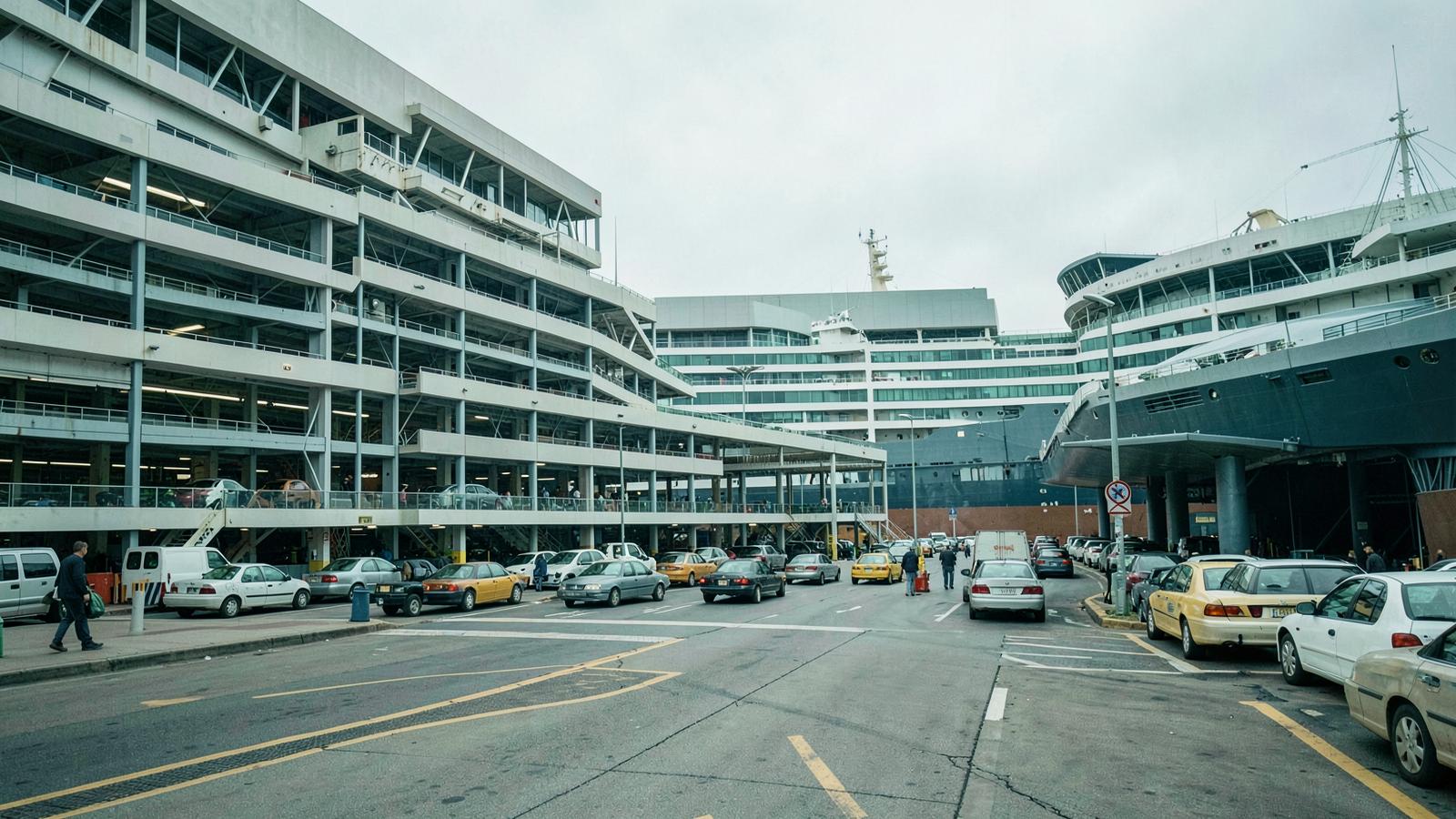
Flights or driving, transfers, parking, and any hotel night held before departure or after disembarkation.
This layer is often outside the cruise quotation because much of it is purchased from third parties; some fare types explicitly include air or transfers. It is also the layer with genuinely published official rates: port authorities issue parking tariffs like any other terminal charge, and they change their own rules — Port Everglades publishes its cruise parking rates, and JAXPORT altered how parking can be arranged in June 2026. The size of this layer is a function of where the reader lives relative to the gateway, not of the voyage.
Station 6
Protection and paperwork
Travel insurance, and any visa or entry documentation the itinerary requires.
On mainstream ocean voyages this is a decision. On some expedition voyages it is a condition of carriage: Quark Expeditions requires passengers on its Antarctic voyages to hold insurance covering emergency evacuation, because evacuation from a remote operating area is not a service that can be improvised. Where an operator imposes the requirement, the cost of meeting it belongs inside the comparison rather than beside it.
Time as a cost layer
The clock is part of the price
A booking is not a purchase completed at one moment. It is a schedule of commitments, and the dates on that schedule carry costs of their own.
Stage 1
Booking
A deposit is taken and the fare code is locked.
The deposit type is itself a price. Royal Caribbean's non-refundable-deposit fares forfeit the deposit if the booking is cancelled; a refundable deposit generally costs more up front in exchange for that option.
Stage 2
Between booking and final payment
The booking is held; the balance is not yet due.
This is the period in which most repricing, cabin changes and cancellation decisions can still be made at the lowest cost. It is also the period in which a contractual price revision, where the contract allows one, would arrive.
Stage 3
Final payment
The balance falls due on a schedule set by voyage length.
Royal Caribbean's schedule runs on tiers by voyage length rather than a single deadline, so the date the money is actually needed differs between a short sailing and a long one booked on the same day.
Stage 4
Cancellation bands
After final payment, refunds step down in date-based tiers.
Cancelling is not a single penalty but a staircase: the same decision costs progressively more the closer it is taken to departure.
Stage 5
Sailing
The onboard account opens.
From here the remaining variable layer accumulates daily and settles once.
The uncomfortable part
Can the number move after you book?
The reassuring answer is common and wrong. Both the contracts and the regulation say the number can move, in defined circumstances.
- Packages sold under EU rules
- A package price may be increased after the contract only where the contract expressly allows it, only for fuel and energy costs, third-party taxes and fees, or exchange rates, and only with a matching right for the traveller to a reduction when those costs fall. Where an increase exceeds 8% of the package price, the traveller may terminate without paying a termination fee.
- Passage contracts generally
- Cruise passage contracts commonly reserve a right to add a fuel supplement after booking. The document is the place to read that clause; the trigger and the amount are terms of the individual contract rather than an industry standard.
- What this rules out
- It rules out the assumption that a paid deposit fixes the number. It does not follow that prices routinely move — only that a booking is a contract with revision terms, and those terms are readable before it is signed.
Above 8%, an EU package traveller may terminate without a fee
Under the EU package travel directive, a post-contract price increase is permitted only where the contract allows it and only for fuel and energy costs, third-party taxes and fees, or exchange rates — with a matching right to a reduction. Where the increase exceeds 8% of the package price, the traveller may terminate the contract without paying a termination fee.
Why two totals are not comparable
The inclusion inversion
Ocean, river and expedition operators do not price the same trip differently. They draw the boundary of the package in a different place, so the advertised number represents a different share of the voyage.
Mainstream ocean
Built around a low entry fare with a broad onboard offer sold separately.
Layers inside the fare against layers outside it. A count of layers, not a share of cost.
Usually inside the fare
- Cabin and passage
- Main dining
- Most entertainment
Usually outside it
- Taxes and port expenses in many markets
- Service charges
- Most drinks and connectivity
- Shore excursions
- Getting to the gateway
River
Built around a higher entry fare carrying more of the voyage inside it.
Layers inside the fare against layers outside it. A count of layers, not a share of cost.
Usually inside the fare
- Cabin and passage
- Meals
- A shore excursion in each port on some fare models
- Wi-fi and meal-time drinks on some fare models
Usually outside it
- Getting to the gateway
- Premium drinks and optional tours
- Insurance
Expedition
Built around an operation where the activity ashore is the product and cannot be bought locally.
Layers inside the fare against layers outside it. A count of layers, not a share of cost.
Usually inside the fare
- Cabin and passage
- Landings and zodiac operations
- Expedition team and briefings
- Outerwear and loaned activity equipment on some operators
Usually outside it
- Reaching a remote gateway, sometimes by charter flight
- Insurance the operator requires
- Optional activities
This is why two advertised figures are not two prices for the same thing. They are drawn at different points on the same accumulation, and the gap between them is not the difference in what the trip will require.

Method
Normalising two quotes without a price list
You do not need to know what anything costs to make two numbers comparable. You need to know where each number was cut.
- 1. Find the cut
- For each quote, mark which of the seven layers is already inside the figure. Taxes and service charges are the two that most often sit on opposite sides of the line between two quotes.
- 2. Fix the party, not the person
- Re-price both quotes for the actual number of people in the actual cabin. A per-person figure built on double occupancy is not a number you can multiply.
- 3. Add the layer neither of them mentions
- Reaching the gateway is set by third parties and appears in no quotation. It is a function of where you live, and it can differ between two otherwise similar voyages purely because they start in different places.
- 4. Separate the conditional from the chosen
- Insurance an operator requires as a condition of carriage belongs inside the comparison. A drinks package does not; it belongs in a second, personal line you control.
- 5. Read the timeline as a price
- A cheaper fare with a non-refundable deposit and an earlier final payment is a different product from a dearer fare with a refundable one. What differs is the cost of changing your mind.
- 6. Read the contract's revision clause
- Check whether the contract reserves a right to add a fuel supplement or otherwise revise the price, and what protections apply in the market you are buying in.
Done properly, this produces two figures that describe the same thing. It does not produce a recommendation, and it will not tell you which voyage is better value — that depends on what you would have spent anyway and what you would never use. What it does is remove the single most common cause of a cruise costing more than expected: comparing two numbers that were never measuring the same trip.
For the orientation-level view of what a fare can contain, see what a cruise fare includes.
Sources & verification
This guide contains no prices. Regulatory thresholds are cited to the instrument, and operator-specific rules are attributed to the operator that publishes them and are not presented as industry standards. Rates and schedules published by operators change; the mechanism is the durable part.
- 14 CFR § 399.84 — Price advertising and opt-out provisions (US DOT full-fare rule) — read 2026-09-01
- Directive (EU) 2015/2302 on package travel and linked travel arrangements — read 2026-09-01
- PortMiami — Terminal Tariff No. 010 — read 2026-09-01
- Port Everglades — cruise parking rates — read 2026-09-01
- JAXPORT — cruise terminal parking — read 2026-09-01
- Royal Caribbean International — official website — read 2026-09-01
- Carnival Cruise Line — official website — read 2026-09-01
- Norwegian Cruise Line — official website — read 2026-09-01
- Viking — official website (inclusive value) — read 2026-09-01
- HX (Hurtigruten Expeditions) — official website — read 2026-09-01
- Quark Expeditions — official website — read 2026-09-01
- CLIA / Tourism Economics — Contribution of Cruise Tourism to the Global Economy — read 2026-09-01