Skip to content
SnapVoyagesIndependent cruise information
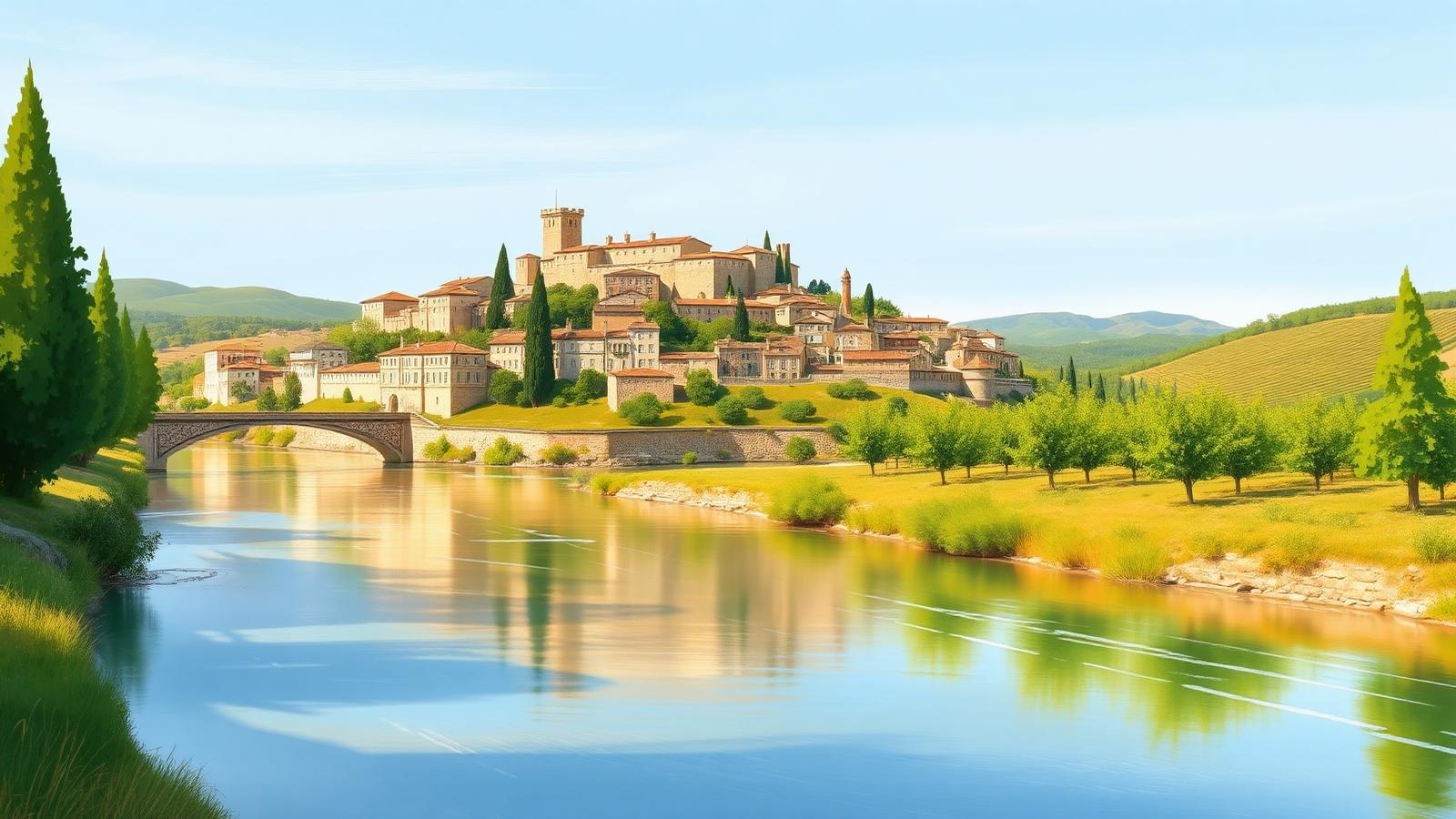
Illustrative AI-generated scene of a river running past a stone town and vineyard hills under southern European light

River cruise system

Rhône and Saône River Cruises

The Rhône and the Saône are cruised as one corridor through eastern France, joining at Lyon. Together they run from Burgundy to Provence — two rivers with opposite characters used as a single north–south route.

The short answer

This is a two-river system treated as one voyage. The Saône above Lyon is slow, gentle and lightly locked; the Rhône below Lyon is fast, deeply locked and strongly engineered. Where a voyage begins therefore says a lot about what the days will feel like.

The corridor is short — Chalon-sur-Saône to Arles is roughly 350 river kilometres — but the change along it is large. Burgundy, the Lyonnais and Provence are distinct regions with distinct food, architecture and climate, and they are passed within a few days.

At a glance

Where it runs
Eastern and southern France, from Burgundy to the Mediterranean
Length
Rhône about 813 km; Saône about 480 km
Countries
France (the Rhône rises in Switzerland, above the cruised reach)
Cruised stretch
Chalon-sur-Saône or Lyon downstream to Avignon and Arles
Season
Roughly March to November
Main start and end points
Lyon, Chalon-sur-Saône, Avignon, Arles

The Rhône & Saône as a corridor

  1. River

    Rhône & Saône

    Eastern and southern France, from Burgundy to the Mediterranean

  2. Cruised stretch

    Chalon-sur-Saône or Lyon downstream to Avignon and Arles

  3. Stretches

    2 in downstream order

    The Saône → The Rhône

  4. Places along it

    7 cities and stops

    Listed in downstream order further down this page.

Why a river is not a region

One waterway, in a fixed order

A cruise region can be entered from several directions. A river corridor can only be travelled upstream or downstream along the same line.

Direction matters more here than on most European rivers. The Rhône runs quickly to the sea, so downstream and upstream legs cover ground at noticeably different rates and the same itinerary can be structured differently in each direction.

The Rhône & Saône corridor

The river's own course, with the cities river cruises use. Select a stretch to focus on it.

Chalon-sur-SaôneMâconLyonVienneTournon-sur-RhôneAvignonArles

Every city on the map

  • Chalon-sur-SaôneFrance, stop, and a start or end point.
  • MâconFrance, stop along the way, serving The Mâconnais and Beaujolais vineyards.
  • LyonFrance, stop, and a start or end point.
  • VienneFrance, stop along the way.
  • Tournon-sur-RhôneFrance, stop along the way, serving Tain-l'Hermitage on the opposite bank.
  • AvignonFrance, stop, and a start or end point.
  • ArlesFrance, stop, and a start or end point.

The line is the river's own course, not the track of any voyage. Cities are the ones needed to understand the corridor, not a complete list of everywhere a vessel can tie up.

What cruising the Rhône & Saône actually means

Two rivers with opposite behaviour
The Saône is slow and shallow-locked; the Rhône is fast and has some of the deepest navigation locks in Europe. The join at Lyon is a real change, not an administrative one.
Heavily engineered, so dependable
The Rhône is controlled by a chain of dams and locks built for navigation and power. That regulation means water levels here are far less of a recurring problem than on the free-flowing German rivers.
A short route through several regions
Burgundy, Lyon and Provence sit within a few days of each other. The corridor is compact, so time under way is short and time ashore is comparatively long.
A southern climate at both ends of the season
The Provençal end of the corridor is Mediterranean, which extends the practical season earlier into spring and later into autumn than on rivers further north.
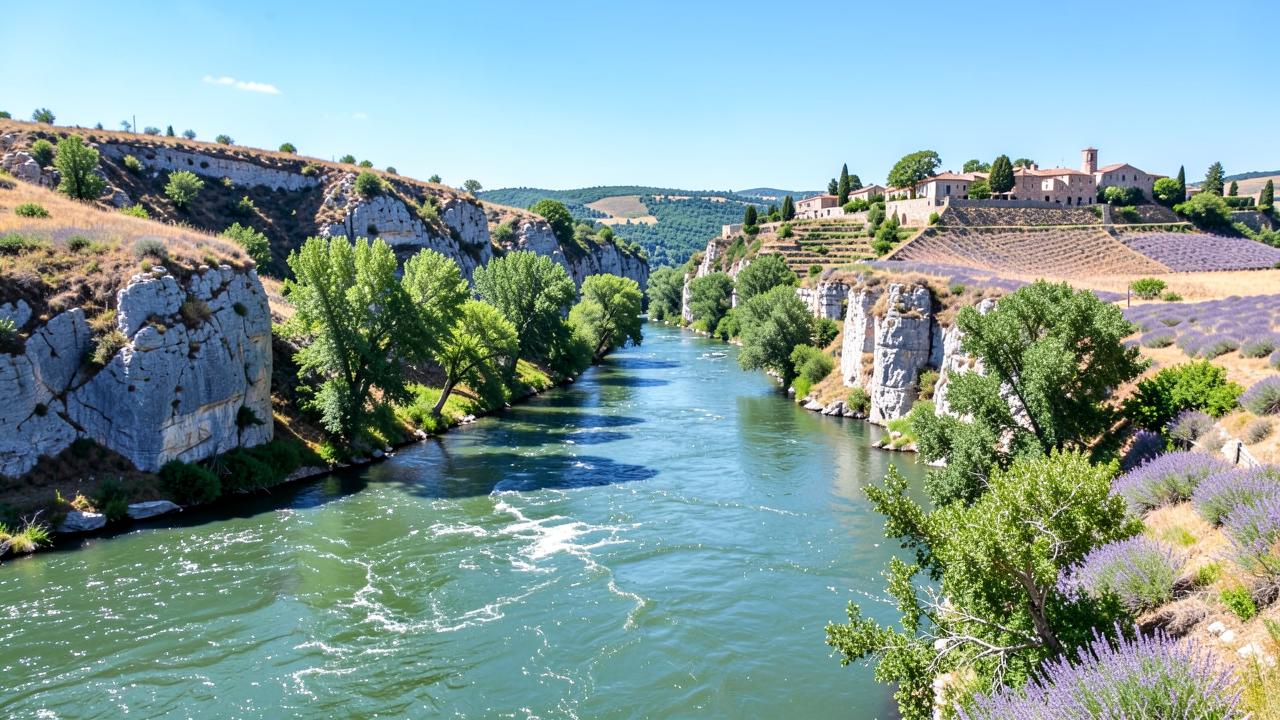
A fast river in southern France between limestone hills with plane trees and a hilltop stone village
The southern half of the corridor: a stronger current, drier country and hill settlements set back from the bank.

Why this is really two rivers with opposite personalities

A Rhône voyage almost always includes the Saône, and the two behave differently. The Saône is slow, wide and placid through Burgundy; the Rhône below Lyon is a powerful river falling towards the Mediterranean, and it was heavily engineered in the twentieth century with large dams and deep locks to make it dependable for navigation and power.

The consequence for a passenger is that the two halves of the same voyage feel unlike each other. The Burgundy stretch is gentle sailing between small towns; the Rhône stretch involves big locks, faster water and a landscape that turns progressively southern — vineyards, then olive trees, stone villages and Roman remains.

Direction matters here more than on most rivers. Sailing downstream with the current is quicker than working back up against it, which is why southbound and northbound voyages over the same route do not spend their time in the same way.
How the two halves of the corridor differ. Qualitative comparison of geography and sailing.
 The waterThe sailingThe landscape
SaôneSlow-moving and comparatively gentle.Short runs between small Burgundian towns.Green farmland, vineyards and low hills.
RhôneFast and strong, controlled by large dams.Deep locks and longer legs between stops.Progressively Mediterranean: stone, olive, Roman.

The main stretches

A river has an order rather than fuzzy edges. These are the stretches the corridor divides into, in the direction the water flows.

The Saône

Chalon-sur-Saône downstream to LyonFrance

A calm, slow tributary running south through Burgundy to meet the Rhône at Lyon. The interest is agricultural and gastronomic country — vineyards, market towns, and the Beaujolais and Mâconnais slopes — rather than dramatic riverscape.

Navigation: Wide, gentle and lightly locked. Current is weak, so upstream and downstream passage take much the same time.

The Rhône

Lyon downstream to Arles and the CamargueFrance

The southern half of the corridor, and a different river: fast-flowing, straightened and strongly channelled between Lyon and the Mediterranean. The country changes from Burgundian to Provençal within a day, and the last stops sit among Roman remains at Avignon, Arles and Vienne.

Navigation: Engineered by a chain of large dams and deep locks. The Rhône has some of the deepest navigation locks in Europe, and the current downstream is strong enough that direction of travel measurably changes running times.

Cities and stops along the river

The main places along the corridor, in downstream order within each stretch.

Cities and stops used by Rhône & Saône river cruises
PlaceCountryStretchRoleWhy it matters
Chalon-sur-SaôneFranceThe SaôneStop, and a start or end pointThe usual northern end of the corridor, in southern Burgundy.
MâconFranceThe SaôneStop along the wayServes The Mâconnais and Beaujolais vineyards.
LyonFranceThe RhôneStop, and a start or end pointThe junction of the two rivers and the natural midpoint of the corridor. The historic centre is World Heritage listed.
VienneFranceThe RhôneStop along the wayA Roman town on the right bank, roughly half a day downstream of Lyon.
Tournon-sur-RhôneFranceThe RhôneStop along the wayServes Tain-l'Hermitage on the opposite bank.
AvignonFranceThe RhôneStop, and a start or end pointMoorings lie beside the walled city; the papal centre is World Heritage listed.
ArlesFranceThe RhôneStop, and a start or end pointThe southern end of the cruised Rhône, at the edge of the Camargue delta.

How voyages are structured

The shapes voyages take along this corridor: where they start, which way they run and how far they reach.

Burgundy to Provence

The full corridor, from Chalon-sur-Saône through Lyon to Avignon or Arles, run in either direction.

Lyon-based Rhône voyages

Voyages that stay south of Lyon, concentrating on the Rhône valley, the Roman towns and Provence.

Round trips from Lyon

Out-and-back structures using Lyon as the base, covering part of both rivers rather than the whole corridor.

When voyages operate

The southern end of the corridor is Mediterranean, so voyages start earlier and finish later here than on most European rivers.

The mistral — a strong, cold north wind down the Rhône valley — is a normal feature of the corridor, most frequent in winter and spring. It affects comfort on deck and occasionally manoeuvring at moorings.

There is no substantial December pattern on this corridor; the Christmas-market season belongs mainly to the Rhine, Main and Danube.

Cruise activity through the year — the Rhône & Saône
Essentially no cruisesShoulder periodPeak cruise activityLow season
Read this as a table
Relative cruise activity by month in the the Rhône & Saône cruise region
MonthCruise activity
JanEssentially no cruises
FebEssentially no cruises
MarShoulder period
AprPeak cruise activity
MayPeak cruise activity
JunPeak cruise activity
JulPeak cruise activity
AugPeak cruise activity
SepPeak cruise activity
OctPeak cruise activity
NovLow season
DecEssentially no cruises

An indicative pattern of when voyages operate, drawn from waterway and season information rather than any operator's schedule.

Practical conditions that shape a voyage

Conditions on this river that can change what actually happens on a voyage.

Deep locks are a visible part of the day

Several Rhône locks drop or raise a vessel more than twenty metres inside a closed chamber. Transits are routine but slow, and they are one of the defining sights of the corridor.

The mistral is a normal condition

Strong valley wind is expected rather than exceptional in the south, and it can affect open-deck use and mooring arrangements.

Not all stops are in the town centre

Avignon and Arles moor close to their historic cores; other stops are quays on the edge of a village with the destination further inland.

Direction changes the timetable

The Rhône's current is strong enough that downstream and upstream legs cover the same distance at different speeds, which shapes how a voyage is laid out.

What to know about the Rhône & Saône

Key facts

  • The Rhône is about 813 km long and the Saône about 480 km; they meet at Lyon.
  • The cruised corridor is roughly Chalon-sur-Saône to Arles.
  • The Rhône is regulated by a chain of dams and locks, several of which are among the deepest in Europe.
  • The historic centre of Lyon and the papal centre of Avignon are UNESCO World Heritage sites.
  • The corridor ends at the Camargue, the Rhône's delta on the Mediterranean.
  • The mistral is a recognised regional wind along the lower Rhône valley.

What to check when comparing voyages

  • Whether the voyage includes the Saône, the Rhône, or both.
  • The direction of travel, which changes the pace of each leg.
  • Which stops are walk-off and which are inland by road.
  • Whether the itinerary reaches Provence or stops at Lyon.
  • That shoulder-season sailings here are genuinely usable, unlike further north.
  • Danube river cruises

    A west-to-east corridor from Germany to the Black Sea, cruised mainly between Passau, Vienna, Budapest and the Danube Delta.

  • Rhine river cruises

    A south-to-north corridor from Basel to the Dutch delta, built around the Upper Middle Rhine Valley gorge.

  • Seine river cruises

    A short French corridor from Paris downstream through Normandy to Rouen and the Seine estuary.

  • Douro river cruises

    A short Portuguese valley from Porto upstream through the terraced Alto Douro wine country to the Spanish border.

  • Main and the Main–Danube Canal river cruises

    The German connecting corridor from the Rhine at Mainz through Franconia and the Main–Danube Canal to Kelheim.

  • Moselle river cruises

    A narrow German wine valley from the Rhine at Koblenz upstream past Cochem and Bernkastel to Trier and Luxembourg.

  • Elbe river cruises

    A Czech–German corridor from Prague and the sandstone gorge through Dresden and Magdeburg to Hamburg.

  • Nile river cruises

    A short Egyptian reach between Luxor and Aswan linking the temple sites, plus a separate Lake Nasser circuit.

  • Mekong river cruises

    A Vietnam–Cambodia corridor from the Mekong delta through Phnom Penh towards the Tonlé Sap and Angkor.

  • Mississippi river cruises

    The long North American corridor from New Orleans upstream to St. Paul, with Ohio and Cumberland connections.

  • Columbia & Snake river cruises

    A Pacific Northwest corridor from Astoria and Portland through the Columbia Gorge and up the Snake to Idaho.

  • How river cruising differs from ocean cruising

    The structural differences: locks, water level, city-centre mooring and no sea days.

Sources & verification

Facts on this page are taken from the sources below. Cruise lines are used only as sources for facts about their own operations, never as sources of independent assessment.