River
When to take a European river cruise
Europe's river season runs roughly from late March to December. Within it, the calendar sets the weather and daylight, but the water — not the date on the brochure — sets whether a ship can sail its route.
The short answer
Most European river cruises run from about late March to early November, plus a separate late-November to December season for Christmas markets. Spring and autumn are milder and quieter; summer is warmest with the longest days; December trades daylight and mild weather for markets and festive lights. None of that calendar choice determines whether the river itself cooperates.
No month is immune to disruption. Low water from a dry spell can leave a ship unable to float fully loaded, and high water after heavy rain or snowmelt can leave it unable to pass under a fixed bridge. Documented cases exist from June (2013 floods), high summer and autumn (2018 and 2022 droughts), September (2024 floods) and July (2026 drought) — so "pick a safe month" is not a claim this guide can make honestly.
By The SnapVoyages TeamPublished October 2026
The honest answer
There is no month guaranteed free of water disruption
Choosing a month for a European river cruise is really two separate decisions: which season suits the trip you want (weather, daylight, crowds, markets), and how much itinerary flexibility you are willing to accept if that year's rainfall or drought happens to fall on your sailing. The sections below treat these as separate questions, because conflating them produces false reassurance.
3 documented low-water and 2 documented high-water disruption episodes since 2013
A small, hand-picked set of well-reported cases (2013, 2018, 2022, 2024, 2026), not an exhaustive count of every disruption. It illustrates that both failure modes recur in different months and different years, not how likely either is in any given year.
The calendar
What each season is like
- Main seasonlate Mar – early Nov
- Christmas marketslate Nov – Dec
- Longest daysmid-May – mid-Aug
An operating pattern described from the river datasets on this site, not a schedule. Most ships do not sail from January to mid-March.
| Weather and light | What changes on board | Water-level exposure | |
|---|---|---|---|
| Spring (Mar–May) | Cool to mild, lengthening days | Blossom and early-season quiet | Snowmelt and rain can raise levels |
| Summer (Jun–Aug) | Warmest, longest days, heat waves possible | Busiest towns | Dry spells can lower levels, especially late summer |
| Autumn (Sep–Nov) | Cooling, shorter days | Harvest and wine season | Low water often persists into early autumn; autumn rain can bring high water |
| Winter (Dec) | Cold, short days | Christmas markets, more time indoors | Usually less affected, but not exempt |
Why not just publish a 'best month' table with scores?
A simple score per month would imply a precision the hydrology does not support. Whether a river is navigable in any given week depends on that year's rainfall and snowmelt across its entire catchment, not on the calendar date.
What can honestly be shown is the seasonal pattern of weather and tourism (reliable from year to year) separately from the pattern of water-level risk (which recurs across different months in different years). The month-by-month table above covers the first; the sections below cover the second.
The mechanism
High water and low water
Too much
High water
- A raised level reduces clearance under fixed bridges, so a ship's superstructure may no longer fit through.
- Waterway authorities restrict or close navigation above set gauge marks, independent of what any single operator wants to do.
- Usually follows heavy or prolonged rain, or rapid snowmelt; levels can rise within days, as in the 2013 and 2024 floods.
Too little
Low water
- Reduced depth means a loaded ship may run aground or be unable to clear the channel bed on shallow stretches.
- Ships may be restricted to partial loading, rerouted, or taken out of service for the affected stretch.
- Develops over weeks of dry weather and can persist for months, as in the 2018 and 2022 droughts.
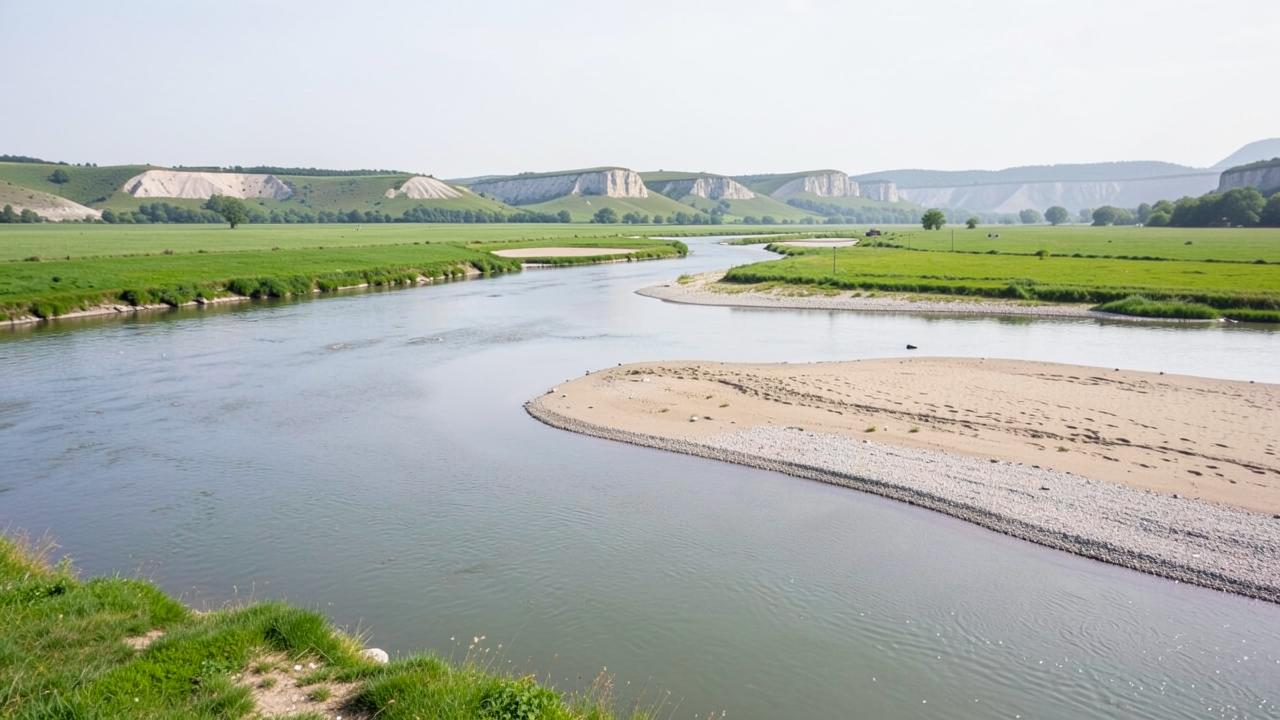
Why does draft matter so much on a river but barely at all at sea? A river boat's hull is designed shallow enough to clear the shallowest stretch on its route in a typical year; the trade-off is that the same shallow draft leaves very little margin when a dry spell drops the river further than usual. Sea-going ships operate in water that is almost always far deeper than their draft, so the same kind of seasonal shortfall essentially never applies to them.
Evidence, not forecasting
Documented disruption, by year
These are specific, reported episodes — useful for understanding what a disruption actually looks like, not for predicting the next one.
2013
June
High water
Danube, Elbe
Heavy rain from 30 May to 2 June on saturated ground produced major floods on the Danube and the Elbe; new record water levels were set on the Elbe below Wittenberg (BfG). River-cruise lines cancelled or altered sailings while sections were closed (Travel Weekly).
2018
Jul–Nov
Low water
Rhine, Elbe
A long drought lowered German rivers for months, first in the north and east, later on the Rhine; on the Middle Rhine the lows that impaired shipping arrived in mid-November (BfG). Kaub's daily-mean flow on 22 October 2018 is among the lowest on record. River cruises were disrupted into the Christmas-market season (New York Times, 28 Nov 2018).
2022
August
Low water
Rhine
In a Europe-wide drought the Kaub gauge fell to 32 cm on 15 August (DW, citing the waterways office); some vessels could not sail even when empty (Reuters, 19 Aug). River-cruise lines adjusted itineraries (New York Times, 29 Aug 2022).
2024
September
High water
Danube
After Storm Boris, Central Europe had its worst floods in at least two decades (Reuters, 18 Sep); in Budapest the Danube peaked on 21 September close to the 2013 record (AFP via France 24, 21 Sep). River-cruise lines amended Danube itineraries (Cruise Critic, Travel Market Report).
2026
July
Low water
Danube
Reuters reported Danube levels near the all-time low in Hungary and the lowest in Romania since 1996, stranding vessels and prompting ship swaps.
Two points follow from this short record. First, both failure modes have occurred in summer, autumn and even in a single named month (the Danube saw low water in July 2026 and high water in September 2024 — two years apart, same stretch of river). Second, the typical operator response is consistent across all five episodes: ship swaps between unaffected sections, coach transfers between ports, revised mooring points, or, in the more severe cases, cancelled departures — not stranding passengers aboard a ship that cannot move.
Differences
River by river
| Sensitive stretch | Typical exposure | |
|---|---|---|
| Rhine | Middle Rhine (Kaub gauge) | Low water in dry late summers (2018, 2022); high water after Alpine snowmelt and heavy rain |
| Danube | Bavarian stretch; Hungary and Romania in severe drought or flood | Low water in severe drought (Hungary and Romania, 2026); floods after prolonged rain (2013, 2024) |
| Elbe | Much of the cruise stretch | Frequently too shallow in summer; one of the most exposed cruise rivers; low water in 2018 and record floods in 2013 |
| Moselle, Main | Canalised with locks | Locks keep depth more stable; high water still restricts navigation |
| Douro | Dammed and locked | Depth regulated by dams; floods possible after winter rain |
Each river's profile is on the river cruises pages; the two main rivers are compared in detail in Rhine vs Danube, including how the Danube's eastern and western sections differ in water-level behaviour.
What it means for you
Understanding your itinerary's flexibility before you book
When a river becomes impassable, the operator's playbook is broadly the same whichever river or year it is: substitute a different ship on the navigable section, move passengers between vessels, add coach transfers to cover a skipped or swapped port, or — if the disruption is severe and ongoing, as in parts of 2018 and 2024 — cancel the sailing outright. None of this is guaranteed to happen smoothly, and the quality of the substitute experience varies by operator and by how much notice they give.
- Ask before booking, not after
- What is the operator's stated contingency for low or high water on this specific river and month? Some publish a water-level policy; others only react case by case.
- Check the gauge, not the forecast
- Close to departure, consult the waterway authority's current readings (BfG, ELWIS, viadonau) rather than seasonal averages. These describe the coming days, not a year out.
- Separate the cruise from the rest of the trip
- A flight, a pre- or post-cruise hotel and an onward connection are not covered by a cruise line's itinerary-change policy. Build in slack around the sailing dates.
- Know what "ship swap" and "bus transfer" actually involve
- They mean a different cabin configuration, possibly a different ship class, and road travel replacing part of the river journey — not a cancelled holiday, but a different one.
Three travellers
How the same calendar suits different priorities
Hypothetical — labelled example
Wants the Christmas markets
- What matters most
- A specific, date-bound experience: the markets are only open in late November and December.
- A reasonable fit
- Books a December sailing and accepts that water-level disruption, while usually less severe in winter, is not impossible — 2018's low water ran into the market season.
- The trade-off to accept
- Lower flexibility on dates, because the experience itself is seasonal, not just the weather.
Hypothetical — labelled example
Wants reliable warm weather and long days
- What matters most
- Daylight and temperature for sightseeing, with less concern about which exact towns are visited.
- A reasonable fit
- Books June to August, accepting that late-summer drought risk to water levels is at its highest in this window (as in 2018 and 2022).
- The trade-off to accept
- Trades a higher chance of itinerary substitution for the most reliable weather and the longest touring days.
Hypothetical — labelled example
Wants the calmest, quietest trip with the fewest surprises
- What matters most
- Predictability and low crowds matter more than any single port or event.
- A reasonable fit
- Books shoulder-season sailings (spring or autumn) and chooses an operator with a clearly stated water-level contingency policy and refundable terms.
- The trade-off to accept
- Accepts that no shoulder month removes the risk entirely — only the historical record of the specific river and recent rainfall can speak to current conditions.
Honesty about data
The limits of historical seasonality
Why can't a 'safest month' be named?
Water level depends on that year's rain, snow and heat across a whole catchment. A month that is reliable in most years can be the problem month in a drought or flood year, as 2013, 2018, 2022, 2024 and 2026 each show for different months and different rivers.
Current gauge readings and forecasts from waterway authorities describe days and weeks ahead. They are the right tool close to departure, not a basis for choosing a month a year in advance.
The five dated examples above were chosen because they were well reported, not because they form a representative sample of every year since 2013. Years without a notable news story about river levels are not necessarily years without any disruption, and years with one are not necessarily worse than average across the whole season.
Choose the season for the weather and the experience; accept the water as genuinely uncertain
Sources & verification
Hydrology and navigation rules from German and Austrian waterway authorities; water-level facts in the events table come from BfG records or named news reports; cruise-operation consequences come from the specific articles cited. Current readings are deliberately not presented as seasonal facts.
- German Federal Institute of Hydrology (BfG) — low water on federal waterways — read 2026-10-10
- ELWIS — Kaub gauge water-level forecast — read 2026-09-01
- Binnenschifffahrtsstraßen-Ordnung §17.11 — navigation at high water — read 2026-09-01
- viadonau — Austrian waterway administration — read 2026-09-01
- Wasserstraßen- und Schifffahrtsamt Elbe — read 2026-09-01
- Reuters — Near-record low water levels disrupt tourism on Danube (16 July 2026) — read 2026-10-10
- Reuters — Danube water levels reach lowest in 30 years (20 July 2026) — read 2026-10-10
- BfG (Undine) — Das Hochwasser der Donau im Juni 2013 — read 2026-10-10
- BfG (Undine) — Das Junihochwasser 2013 im Elbegebiet — read 2026-10-10
- BfG — Das Niedrigwasser 2018 (brochure, Feb 2019) — read 2026-10-10
- BfG (Undine) — Das Niedrigwasser des Rheins im Sommer und Herbst 2018 — read 2026-10-10
- BfG (Undine) — Pegel Kaub, Rhein: extreme values — read 2026-10-10
- DW — Rhine River water levels plumb new depths (15 Aug 2022) — read 2026-10-10
- Reuters — Germany's Rhine water too low even for some empty vessels (19 Aug 2022) — read 2026-10-10
- Reuters — Central Europe experiencing worst floods in at least two decades (18 Sep 2024) — read 2026-10-10
- France 24 / AFP — Hungary Danube waters reach decade high after Storm Boris (21 Sep 2024) — read 2026-10-10
- The New York Times — European River Cruises Hit a New Obstacle: Not Enough Water (28 Nov 2018) — read 2026-10-10
- The New York Times — Low Water Levels Disrupt European River Cruises (29 Aug 2022) — read 2026-10-10
- NPR — The Rhine's low water level adds to Germany's economic woes (17 Aug 2022) — read 2026-10-10
- Travel Weekly — More river cruises canceled as floods devastate Central Europe (5 Jun 2013) — read 2026-10-10
- Cruise Weekly — Post-flood Europe set to stabilise (25 Jun 2013) — read 2026-10-10
- Cruise Critic — Danube Cruises Impacted by European Floods from Storm Boris (23 Sep 2024) — read 2026-10-10
- Travel Market Report — Central Europe Floods: How River Cruise Companies Are Adapting (20 Sep 2024) — read 2026-10-10