Ports
What is a tender port?
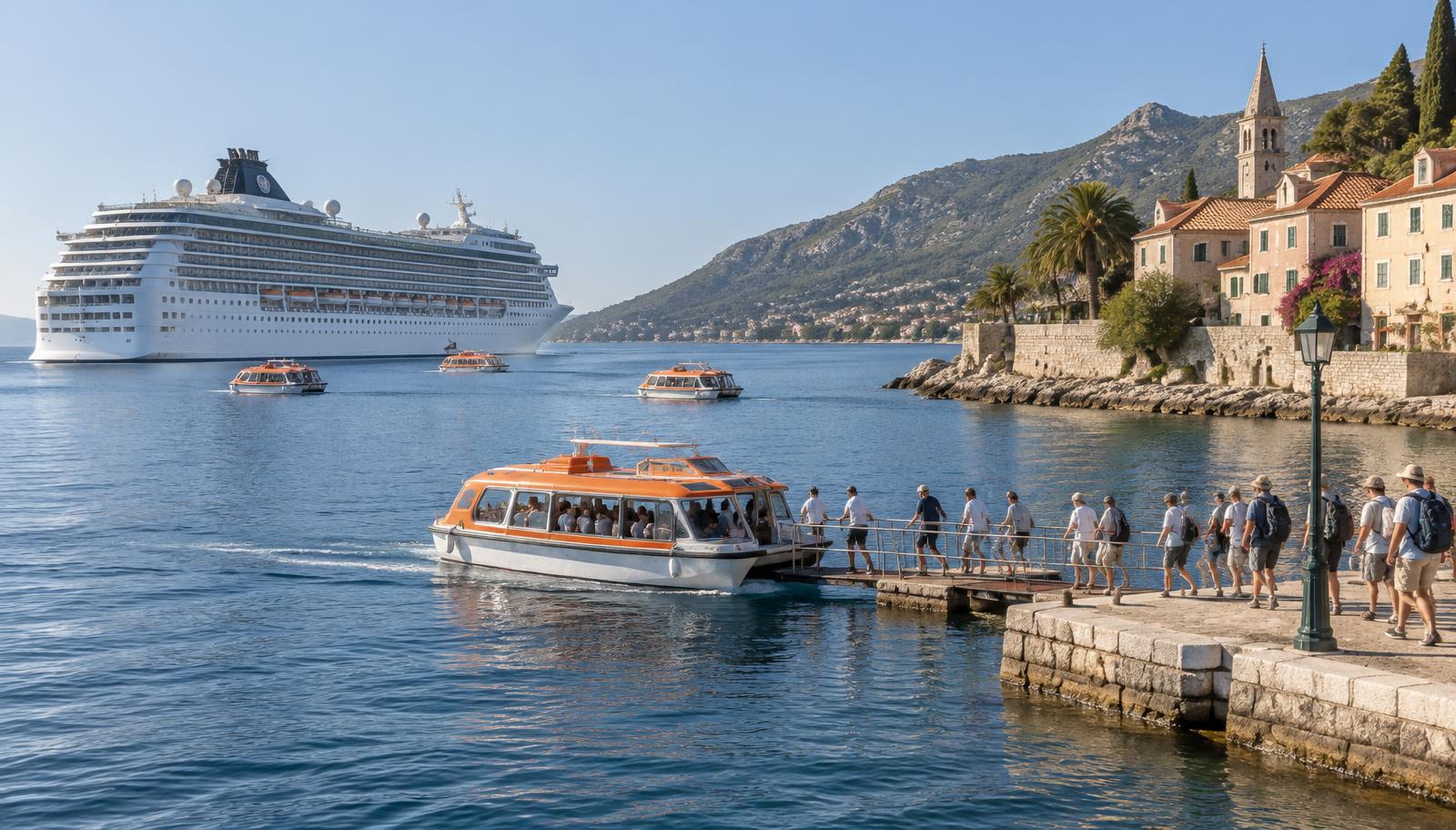
Some ports on an itinerary have no berth the ship can use. The ship stops offshore, and the last stretch to land is made in small boats.
The short answer
A tender port is a port call where the ship anchors (or holds position) offshore instead of mooring at a pier, and passengers are carried ashore in small boats called tenders.
Tendering takes longer than walking down a gangway, runs in batches rather than continuously, depends on sea conditions at the moment of transfer, and can be harder or impossible for some travellers with limited mobility. It is also the only practical way many small, scenic or over-capacity ports can be visited at all.
By The SnapVoyages TeamPublished October 2026
The difference
Docking versus tendering
Alongside a pier
One fixed link. People move ashore and back more or less whenever they like, up to the all-aboard time.
At anchor offshore
A shuttle of small boats, each carrying one load at a time. Getting everyone ashore (and back) takes as many round trips as there are people, divided by what the boats can carry per trip.
Schematic, not to scale and not a specific ship or port. The practical difference is not the boat itself but the loop: a pier is one continuous link, an anchorage is a queue of discrete round trips, each one bounded by how many seats the running tenders have and how long the crossing to shore takes.
| Docked (alongside) | Tendered (at anchor) | |
|---|---|---|
| Getting ashore | Walk over a fixed gangway | Board a small boat, ride to a landing stage |
| Flow of people | Continuous, whenever you like | In batches, limited by boat capacity and crossing time |
| Returning on board | Walk back any time before all-aboard | Last tender times are earlier than sailing time |
| Sensitivity to weather | Low; strong wind can still affect berthing | High; swell at the boarding point can stop operations |
| Step-free access | Usually possible | Often limited; depends on sea state, equipment and the captain's judgement on the day |
| Who decides if it runs | Port authority / pilot, routine | Master of the ship, assessed at the time |
The cause
Why some ports require tenders
- No berth long or deep enough
- Small harbours, islands and historic towns were not built for modern cruise ship draughts or lengths, so there is no quay the ship can safely come alongside.
- Berths already taken
- Where a port has fewer deep-water berths than ships calling on a given day, later arrivals may be assigned to anchor instead of a pier.
- Local capacity and berth-allocation policy
- Some ports actively manage cruise arrivals. Santorini's Municipal Port Fund of Thira, for example, runs a berth-allocation and daily passenger-cap system for the island, partly because its historic port has been affected by seismic activity.
- Protected, remote or scenic coasts
- In expedition and small-ship regions there is often no commercial port infrastructure at all, and every landing is made by small boat as a matter of course.
In practice
How a tender day runs, step by step
The outline below describes the general sequence cruise lines use for tender calls; the order of steps, ticketing method and exact terminology differ between ships and lines, so treat this as a pattern to recognise rather than a fixed procedure.
Before port
Ship anchors or holds position
The master selects an anchorage or dynamically positions the ship; this is confirmed only on arrival, sometimes after a final look at the sea state.
Boarding
Tender tickets or muster groups called
Many lines call passengers in numbered groups or by ticket, often over the public address system or an app; shore-excursion groups are commonly given priority.
Transfer out
Short crossing to the landing stage
Passengers board the tender at a lower deck or platform, ride to a quay or jetty ashore, and disembark.
Ashore
Independent time or excursion
Time ashore is whatever remains of the published port hours once the outbound and expected return transfer are allowed for.
Return
Tenders run back on a schedule, not continuously
Return tenders usually run at intervals rather than on demand; the queue at the landing stage can grow toward the end of the day.
Last tender
A published cut-off, earlier than sailing time
The last tender back to the ship leaves before the advertised departure, to allow time to raise anchor and get underway.
For passengers
What changes on a tender day
- Less effective time ashore
- Waiting and transfer time is drawn from the published port hours, not added on top of them. On a large ship with a single landing stage, the queue at the start of the day can be long.
- Tickets or groups
- Many lines issue tender tickets or call groups in order; shore excursion groups and higher-tier loyalty passengers are often given earlier access, as several lines document for their own itineraries.
- Earlier, firmer return
- The last tender back leaves before the ship sails. Missing it is treated the same as missing the ship at any other port.
- No guaranteed refund for a cancelled call
- If conditions prevent tendering, lines generally treat the missed call the same way as other unscheduled itinerary changes — as a risk of cruising rather than a service failure that is automatically compensated.
- Ship size changes the arithmetic
- A ship with more passengers needs more tender round trips to move the same proportion of guests ashore in a morning. The underlying numbers are set out in what ship size actually changes.
The equipment
Ship tenders, local launches, and the lifeboat question
A "tender" is not one type of boat; it is a role. On many modern cruise ships, some of the vessel's own enclosed lifeboats are built and certified to double as tenders — this is an established design category, built to a combined life-and-tender-boat specification, and it is explicitly covered by International Maritime Organization guidance on how such craft should be constructed, equipped and operated when used to move passengers to and from a stationary ship.
Other ships carry dedicated tender craft that are not certified as lifeboats, built to equivalent passenger-vessel standards instead. At some ports, the transfer is made instead (or partly) by independent local harbour boats or water taxis contracted for the call, which are not part of the ship's own safety equipment at all. Which arrangement applies depends on the ship and the port, not on a single rule, so it is not accurate to describe every tender as "a lifeboat."
Separately from the type of boat, the transfer itself — moving between a moving ship and a moving small craft — is the kind of operation that the UK Maritime and Coastguard Agency's guidance on transferring persons to and from ships treats as inherently higher-risk than a fixed gangway, which is part of why crews control it closely and why conditions that look calm from the dock can still rule it out.
Accessibility
Tenders and limited mobility
Boarding a tender means stepping, at a moment chosen by the crew, between two surfaces that are each moving independently. Several major lines publish broadly similar conditions for this: travellers using non-motorised wheelchairs are commonly required to have a collapsible chair and to be able to take some steps unassisted, motorised wheelchairs and scooters are typically not permitted aboard a tender unless the specific vessel and landing offer a roll-on connection, and crew are generally instructed not to lift guests or equipment for safety reasons. A number of lines are explicit that the final decision on whether any individual passenger may board is made by the captain or senior crew on the day, based on conditions at that moment, and that this decision is not guaranteed in advance.
Tendering also compounds with the facilities ashore: a landing that has no ramp, lift or level access from the quay can prevent disembarkation even for a passenger who boarded the tender without difficulty, a point several lines note explicitly in their own accessibility information.
Passenger rights for disabled and reduced-mobility travellers at sea are set out in law in some jurisdictions — for voyages that fall under it, Regulation (EU) No 1177/2010 and equivalent frameworks elsewhere (such as the U.S. Access Board's passenger-vessel accessibility guidance) establish assistance and non-discrimination principles, but they do not override a master's authority to restrict boarding for safety reasons in specific sea conditions. The general principles are set out on practical basics; the operational detail for a specific sailing should always be checked with the line.
Before booking
An accessibility decision checklist
- Identify the tender calls on the itinerary
- Cross-check the day-by-day port list against the operator's own published tender-port information, where available, before assuming a call is a berth.
- Ask the line directly, in writing, before final payment
- Operator policies on mobility devices, collapsible-chair requirements and roll-on availability differ between lines and are revised; several lines ask for advance notice of mobility needs, commonly weeks ahead.
- Understand that approval can still be withdrawn on the day
- Multiple lines state plainly that even a pre-cleared passenger may be refused boarding if conditions at the time of transfer are judged unsafe.
- Check what happens ashore, not just onto the tender
- Ask about the landing stage itself — steps, ramps, distance to accessible transport — since several lines note shore-side access can be the limiting factor even when the tender itself is manageable.
- Plan for a missed call
- Because tendering can be cancelled or restricted with little notice, build itinerary expectations — and any pre-booked shore plans — around the possibility that a given tender port will not be reachable that day.
Predictability
Why a scheduled tender call can still change
Swell and surge at the boarding platform, not the forecast in town
A port can look calm from shore and still be judged untenderable at the ship's boarding point. If the master judges transfers unsafe, the call is reduced, delayed or skipped and the day effectively becomes a sea day.
Because the limiting factor is the motion between the ship and the tender at the exact moment of transfer — not a single daily weather figure — a call that was scheduled weeks in advance as a tender port can be altered on arrival, and a berth call can occasionally be switched to a tender call for the same reason if the usual pier cannot be used safely that day. Neither direction of change is something a traveller can verify in advance; it is an operational decision made on site.
Sources & verification
International guidance on tender construction and operation, a UK Marine Guidance Note on ship-to-ship transfers, a port authority's own berth-allocation policy, several cruise lines' own published accessibility and tender-port policies (cited as sources on their own practices, not as independent assessments), and passenger-rights law. Boarding procedures and equipment differ between lines and are not exhaustively detailed here.
- IMO Maritime Safety Committee — MSC.1/Circ.1417, Guidelines for Passenger Ship Tenders (2012) — read 2026-10-10
- Fr. Fassmer GmbH & Co. KG — combined life- and tender boat specification sheets — read 2026-10-10
- UK Maritime and Coastguard Agency — MGN 432, Safety during Transfers of Persons to and from Ships — read 2026-10-10
- Municipal Port Fund of Thira — Cruise Ship Berthing Policy / arrival evaluation 2025–2026 — read 2026-10-10
- Royal Caribbean — Assistance Onboard & Offshore (accessibility, tendering) — read 2026-10-10
- Virgin Voyages — Tender Ports additional information (accessibility) — read 2026-10-10
- Norwegian Cruise Line — Tender Port List and accessibility notes — read 2026-10-10
- Princess Cruises — Passengers with Limited Mobility (tendering policy) — read 2026-10-10
- Carnival Cruise Line — Water Shuttle Ports FAQ — read 2026-10-10
- Regulation (EU) No 1177/2010 — rights of passengers travelling by sea and inland waterway — read 2026-10-10
- U.S. Access Board — passenger vessel accessibility — read 2026-10-10
Continue
Where this leads
Reading an itinerary
How to spot tender calls and what published port hours mean in practice.
What ship size changes
Why a tender day on a very large ship works differently from one on a small ship.
Glossary
Tender, anchorage, all-aboard and other terms.
Practical basics
Accessibility and practicalities at principle level.